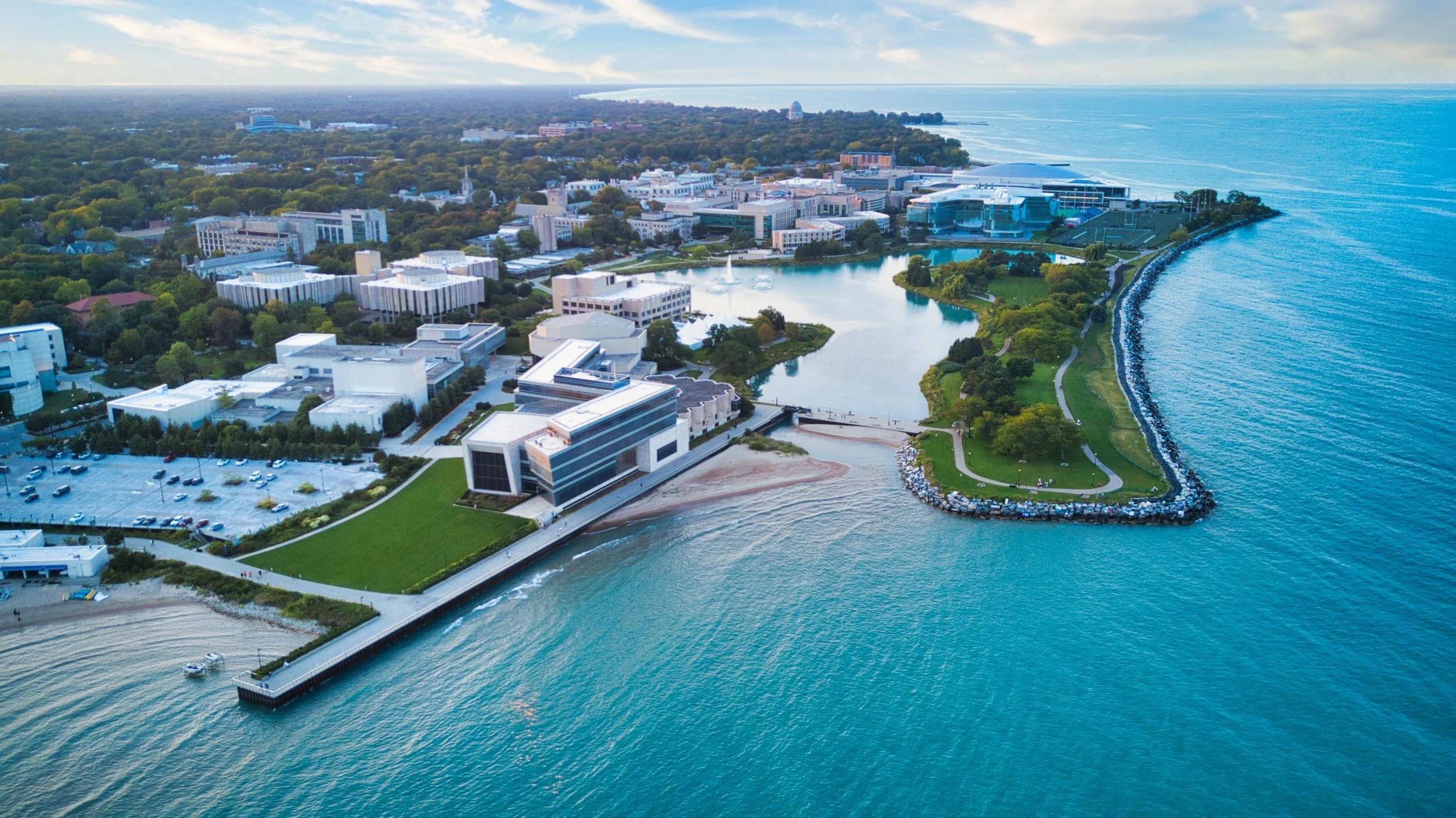
Few universities offer the same combination of academic breadth, lakefront beauty, research intensity, creative energy, and big-city access as Northwestern University. Located in Evanston, Illinois, just north of Chicago, Northwestern brings together a traditional residential university atmosphere with the opportunities of one of America’s most dynamic cities.
Founded in 1851, Northwestern has grown into a comprehensive research university with campuses in Evanston, Chicago, and Doha. The university currently describes its community as approximately 21,000 students, more than 3,300 full-time faculty members, 12 schools and colleges, and hundreds of student organizations.
But numbers only tell part of the story.
The character of Northwestern comes from the connections between its different worlds. An engineering student can explore entrepreneurship. A journalism student can investigate emerging technology. A musician can study the cultural impact of music. A social science student can work with researchers using data and artificial intelligence. Students can move between classrooms, laboratories, studios, athletic facilities, student organizations, Evanston neighborhoods, and Chicago experiences.
That multidimensional environment is at the heart of the Northwestern experience. 🌎✨
🌊 A Campus With a Remarkable Setting
Imagine studying at a research university where Lake Michigan forms part of the landscape.
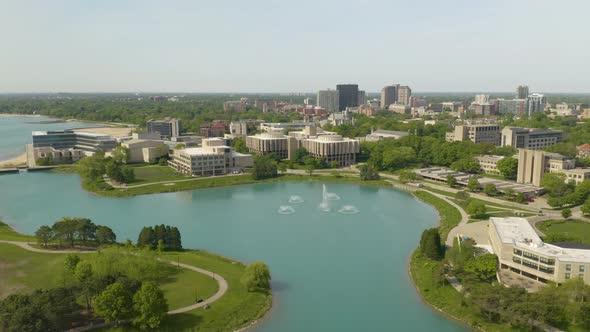
Northwestern’s Evanston campus covers approximately 240 acres and combines academic buildings, residential spaces, green areas, recreational facilities, and lakefront surroundings. The university describes its location as offering natural beauty alongside access to a bustling city.
The lakefront is more than an attractive backdrop. It contributes to the rhythm of campus life. Students can take a walk beside the water, spend time outdoors with friends, participate in recreational activities, or simply find a quiet place to think after a demanding class.
The campus also benefits from its relationship with Evanston. The city provides restaurants, shops, cultural venues, beaches, and neighborhood experiences that complement university life.
Then there is Chicago.
The proximity of Chicago creates a second layer to the Northwestern experience. Students can access museums, theaters, companies, professional organizations, sporting events, cultural institutions, and countless other opportunities while maintaining the atmosphere of a residential university campus.
This combination gives Northwestern a distinctive geographic identity: a college campus beside a Great Lake, situated within reach of a major American city. 🌆🌊
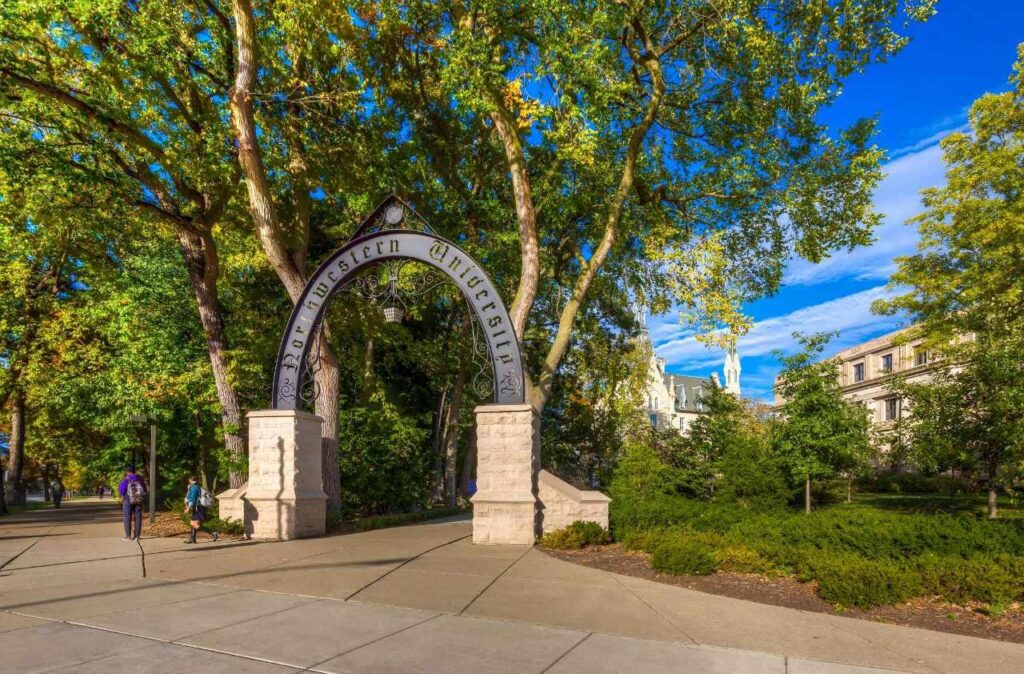
📚 An Academic Experience Built Around Exploration
Northwestern’s academic environment is designed for students who want choices.
The university offers undergraduate, graduate, professional, continuing, and online programs across a broad range of disciplines. Its academic structure includes schools and colleges dedicated to areas such as arts and sciences, communication, education and social policy, engineering, journalism and media, music, medicine, law, business, and professional studies.
For undergraduates, Northwestern highlights more than 4,000 courses offered annually. Its undergraduate admissions materials also emphasize interdisciplinary learning and opportunities to combine different areas of study.
That breadth can change the way students think about education.
Instead of asking only, “What is my major?” students can begin asking broader questions:
What subjects genuinely interest me?
How can two different disciplines inform each other?
What problems do I want to understand?
What skills do I want to develop?
How can classroom knowledge become useful outside the university?
These questions can lead to unexpected academic combinations.
A computer science student may become interested in ethics and public policy. A communication student might explore psychology and technology. An economics student may discover an interest in environmental sustainability. A biology student could investigate entrepreneurship or data science.
Northwestern’s interdisciplinary structure makes these connections especially relevant. The university says 74% of undergraduates combine multiple areas of study, according to its published facts.
🎯 The result is an educational experience that can be customized around individual curiosity.
🔬 Research From the Classroom to the Real World
Research is another defining feature of Northwestern.
The university describes itself as deeply interdisciplinary, with research extending across medicine, engineering, artificial intelligence, sustainability, social sciences, the arts, and other fields. Northwestern currently highlights 22 interdisciplinary research institutes and centers as part of its research ecosystem.
The most exciting aspect is that research is not necessarily something reserved for senior scholars or graduate students.
Northwestern states that undergraduate research can begin early, with its Office of Undergraduate Research providing funding to hundreds of students each year. Its undergraduate admissions materials also describe hundreds of laboratories that students can access regardless of major.
This creates an important shift in the meaning of learning.
Instead of simply receiving information, students can participate in discovering information.
They may formulate questions, examine evidence, conduct experiments, analyze data, build prototypes, interview participants, create artistic work, or contribute to larger faculty-led projects.
Research also encourages students to become comfortable with uncertainty.
Real research rarely begins with a guaranteed answer. Students may encounter unexpected results, revise their assumptions, discover new questions, and learn that complicated problems rarely have simple solutions.
Those habits of mind are useful far beyond academia.
Northwestern’s research priorities also reflect major challenges facing society, including biosciences, artificial intelligence, data analytics, renewable energy, sustainability, and interdisciplinary social science.
For students interested in the future, that environment can be especially inspiring. 🚀
🤖 Innovation, Technology, and Entrepreneurship
The future of education is increasingly connected to innovation.
Northwestern has invested in an ecosystem where research can move toward practical applications. Its research and innovation resources include the Innovation and New Ventures Office, The Garage, and the Querrey InQbation Lab.
The Garage is particularly notable for students interested in entrepreneurship. It provides a community and resources for Northwestern students developing new ideas and ventures.
Entrepreneurship, however, is not limited to launching a company.
It can mean learning how to identify a problem.
It can mean talking to people who experience that problem.
It can mean testing an idea.
It can mean creating a prototype.
It can mean learning from failure.
It can mean persuading a team to believe in an ambitious project.
💡 These abilities can be valuable whether someone eventually works at a startup, a large corporation, a nonprofit organization, a research institution, or a government agency.
Artificial intelligence is another major area of focus. Northwestern identifies data analytics and AI among its institutional priorities, emphasizing their potential across STEM, arts, and humanities.
That cross-disciplinary perspective is important because AI is not simply a computer science issue.
AI affects healthcare, education, journalism, entertainment, business, scientific discovery, public policy, and everyday communication.
Understanding its possibilities and limitations requires technical knowledge alongside ethical, social, and human perspectives.
Northwestern’s broad academic environment gives students opportunities to explore those intersections.
🎭 Creativity Is Part of the Education
A university can be academically rigorous without becoming narrowly academic.
Northwestern places significant emphasis on creative and performing arts. Its School of Communication and Bienen School of Music provide pathways into theater, dance, filmmaking, music, composition, performance, musicology, cognition, and related areas.
Creative activity can also influence students outside formal arts programs.
An engineering student might perform in a music ensemble.
A business student might work on a theater production.
A biology student might take a music course.
A journalism student could explore filmmaking.
Northwestern’s undergraduate admissions materials specifically note that Bienen offers music classes to undergraduates regardless of major.
This philosophy reflects an important idea: creativity is not simply an extracurricular activity. It can be a way of thinking.
Artists experiment.
Scientists experiment.
Entrepreneurs experiment.
Designers experiment.
Researchers experiment.
In each case, people imagine possibilities, test ideas, learn from results, and revise their work.
That is why creative education can complement scientific and professional education so effectively. 🎨🧠
🐾 Student Life Beyond the Classroom
The Northwestern experience continues long after classes end.
The university’s campus experience resources highlight more than 400 student organizations, 19 varsity sports, performances, exhibitions, campus events, libraries, recreation, dining, residential services, and wellness resources.
Student organizations are particularly important because they allow students to build communities around shared interests.
There may be academic clubs, cultural organizations, recreational groups, creative organizations, service initiatives, publications, leadership groups, and many other communities.
For a new student, joining an organization can be one of the easiest ways to meet people outside a residence hall or classroom.
For an experienced student, leadership opportunities can provide another kind of growth.
Organizing an event teaches planning.
Leading a team teaches communication.
Managing a budget teaches responsibility.
Working with people who disagree teaches compromise.
Building a new organization teaches initiative.
These experiences can become just as memorable as individual courses.
Northwestern’s Student Affairs division describes its role as helping students build community, develop skills, navigate challenges, and prepare for the future.
That broader approach recognizes that university students are developing as whole people, not simply collecting academic credits.
🏀 The Wildcat Spirit
Athletics provide another important part of Northwestern culture.
Northwestern is a member of the Big Ten Conference and currently lists 19 intercollegiate athletic teams, alongside club and intramural sports.
For students, athletics can create shared experiences that cross academic boundaries.
A business student and an engineering student may have little reason to meet during the academic day, but they can find themselves cheering for the same team at an athletic event.
That shared identity contributes to campus spirit.
The Wildcat identity also extends beyond sports. University traditions, student events, performances, campus organizations, and community activities all contribute to the feeling of belonging.
🐾 University traditions matter because they create memories.
Years after graduation, students may forget the details of a particular Tuesday afternoon lecture, but remember walking across campus with friends, attending a performance, celebrating a major athletic moment, or participating in a favorite annual tradition.
Those experiences become part of the emotional history of university life.
🌎 Global Opportunities and International Perspectives
Northwestern’s community extends beyond Evanston.
The university has campuses in Chicago and Doha and maintains more than 70 academic partnerships with institutions in more than 30 countries. Northwestern also reports that about half of its students choose to study abroad.
For students, international opportunities can broaden education in ways that a classroom cannot always reproduce.
Studying in another country can introduce different cultural perspectives, educational traditions, languages, professional environments, and social systems.
It can also encourage independence.
Navigating a new city, adapting to unfamiliar customs, working with international classmates, or completing an internship in another country can challenge students to become more flexible.
🌍 Global learning is therefore not simply about traveling.
It is about learning to see familiar questions from unfamiliar perspectives.
That ability is increasingly valuable in a world where professional teams, research collaborations, businesses, and communities are internationally connected.
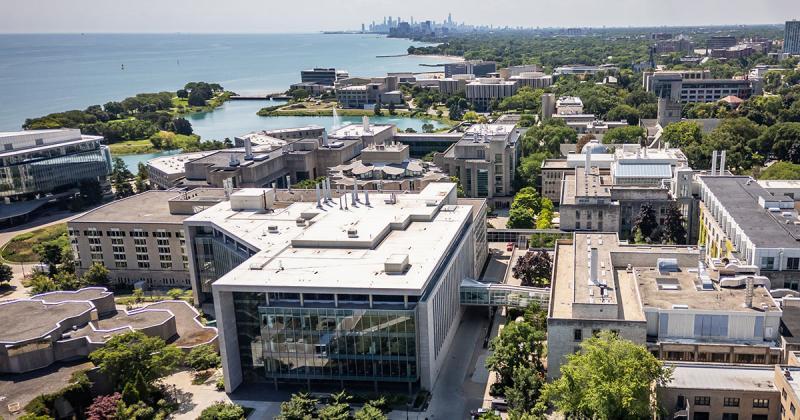
🌆 Chicago as an Extension of the Classroom
One of Northwestern’s greatest advantages is its relationship with Chicago.
The university describes Evanston and Chicago as important parts of the student experience, and its academic programs include experiential opportunities such as Chicago Field Studies.
Chicago can become a laboratory for learning.
Students interested in journalism can observe the media industry.
Those interested in business can explore one of America’s major commercial centers.
Students studying politics can encounter civic institutions.
Aspiring artists can explore museums, galleries, theaters, and music venues.
Healthcare students can learn in a city with major medical institutions.
Entrepreneurs can connect with a large regional business ecosystem.
This relationship between university and city adds practical context to academic education.
A textbook can explain how an urban economy works.
A city allows students to see it.
A lecture can describe cultural institutions.
A city allows students to experience them.
A classroom can discuss professional communication.
An internship can demonstrate what it means in practice.
That interaction between theory and experience is one of Northwestern’s most valuable characteristics.
📖 Libraries and the Culture of Learning
Libraries remain essential even in an era dominated by digital information.
Northwestern describes its libraries as research hubs containing more than 8 million volumes and distinctive collections.
The importance of such spaces goes beyond the number of books.
Libraries provide an environment designed for concentration.
They create opportunities for independent study.
They provide access to specialized research materials.
They support students working on major projects.
And they offer places where intellectual curiosity can continue outside scheduled classes.
At a research university, students gradually move from consuming information to evaluating and producing knowledge.
That requires learning how to distinguish strong evidence from weak evidence, recognize reliable sources, ask precise questions, and develop original conclusions.
📚 Those abilities remain useful long after graduation.
🤝 A Community Designed for Different Directions
One of the most interesting things about Northwestern is that there is no single “Northwestern student.”
The university includes aspiring scientists, journalists, engineers, musicians, entrepreneurs, lawyers, physicians, educators, artists, researchers, business leaders, and many other future professionals.
Its published facts describe a student body of approximately 21,000 and a community spanning 12 schools and colleges.
That diversity creates opportunities for unexpected conversations.
A student might enter Northwestern believing they have a clear career plan and discover an entirely different passion.
Another student may arrive undecided and gradually combine several interests.
Someone else may remain committed to a single field but discover new perspectives through interdisciplinary collaboration.
All three experiences can be valuable.
The goal of a university does not have to be producing identical graduates.
It can be helping individuals develop the knowledge, confidence, curiosity, and skills to create their own direction.
That idea fits closely with Northwestern’s emphasis on an innovative, collaborative, and multidimensional community.
🌟 Why Northwestern Stands Out
So what makes Northwestern distinctive?
It begins with the combination of academic breadth and interdisciplinary depth.
Students have access to a wide selection of subjects while being encouraged to connect fields.
Then comes research.
Students can participate in research and creative projects, while faculty and university research centers tackle questions that cross traditional disciplinary boundaries.
Next is location.
Few university settings combine a lakefront campus, a college-town environment, and proximity to a major global city in quite the same way.
Then there is student life.
Hundreds of organizations, athletics, performances, traditions, recreation, and community activities create opportunities to build relationships outside the classroom.
Finally, there is flexibility.
Students can explore different academic directions, combine interests, participate in international programs, engage in research, develop creative skills, and pursue professional experiences.
That flexibility can be particularly valuable in a rapidly changing world.
💜 The Northwestern Direction
Perhaps the best way to understand Northwestern is not simply as a university where students receive an education, but as a place where they are encouraged to create a direction.
That direction may change.
A first-year student may discover a new subject.
A researcher may uncover an unexpected result.
An entrepreneur may change a business idea.
An artist may discover a new medium.
A student studying abroad may return with a different perspective.
A campus organization may introduce someone to lifelong friends.
Growth rarely happens in a straight line.
Northwestern’s combination of rigorous academics, research, creativity, student organizations, global engagement, and access to Chicago creates room for those unexpected turns.
✨ The Northwestern experience is ultimately about possibility.
It is the possibility of connecting disciplines.
The possibility of transforming an idea into research.
The possibility of turning research into innovation.
The possibility of meeting people who think differently.
The possibility of discovering interests that were not obvious before arriving.
And the possibility of leaving campus with a clearer sense of how knowledge can be used to contribute to the world.
For students searching for a university that combines intellectual ambition with creativity, community, research, and real-world opportunity, Northwestern offers a distinctive environment.
From the shores of Lake Michigan to the energy of Chicago, from laboratories to performance spaces, from student organizations to international opportunities, Northwestern brings many different forms of learning together.