Choosing a university is about much more than selecting a name from a list of institutions. It is about finding a place where curiosity is encouraged, ideas are challenged, friendships are built, and academic ambitions can develop into meaningful careers. For students searching for that combination, Northwestern University offers an environment where rigorous scholarship, creative exploration, interdisciplinary learning, research, and community life come together in distinctive ways.
Located in Evanston, Illinois, just north of Chicago, Northwestern combines the atmosphere of a beautiful lakefront campus with access to one of America’s most dynamic cities. The university also has a major Chicago campus and an international presence in Doha, Qatar, creating an educational environment that extends beyond a single geographic location. Northwestern describes itself as a comprehensive research university with a strong interdisciplinary culture, and its academic structure reflects that philosophy.
The university’s identity has developed over more than 175 years. Founded in 1851, Northwestern began with an ambitious vision to create an institution serving the Northwest Territory. Since then, it has evolved into a major research university with numerous academic schools, thousands of students, hundreds of student organizations, and a global network of partnerships.
But statistics alone cannot fully explain the Northwestern experience. What makes the university especially interesting is the way different elements of university life overlap. A student might study engineering in the morning, participate in a theater production in the afternoon, attend a research meeting in the evening, and spend the weekend exploring Chicago with friends. 🎭🔬🏙️
That mixture of possibilities is at the heart of the Northwestern experience.
A University Built on an Ambitious Vision 🌟
Northwestern’s story begins in the middle of the nineteenth century. On May 31, 1850, a group of founders gathered in Chicago with the goal of establishing a university that would serve the growing region. The Illinois legislature approved Northwestern’s Act of Incorporation in 1851, officially establishing the institution.
The founders were working in a very different America. Chicago was developing rapidly, transportation networks were expanding, and the region was becoming increasingly important economically and culturally. Creating a university in such an environment required ambition, organization, and an understanding that education could help shape the future of a developing region.
Over time, Northwestern grew from that original vision into a university with a broad academic footprint. Its history includes the development of professional schools, research programs, athletics, artistic traditions, and international initiatives.
One of the fascinating aspects of Northwestern’s history is how the university has continued to adapt. Higher education has changed dramatically since 1851, but the institution’s emphasis on intellectual growth and innovation remains central to its identity.
The university’s historic character can still be seen around campus. University Hall, completed in 1869, is among the oldest surviving buildings associated with Northwestern. Historic architecture exists alongside modern academic and research facilities, creating an environment in which the past and future exist side by side. 🏛️✨
That balance is symbolic of Northwestern itself. The university respects traditions while continuously exploring new approaches to teaching, research, technology, and creative expression.
The Evanston Campus: Learning Beside Lake Michigan 🌊🏫
For many students, Northwestern’s physical setting is one of its most memorable features.
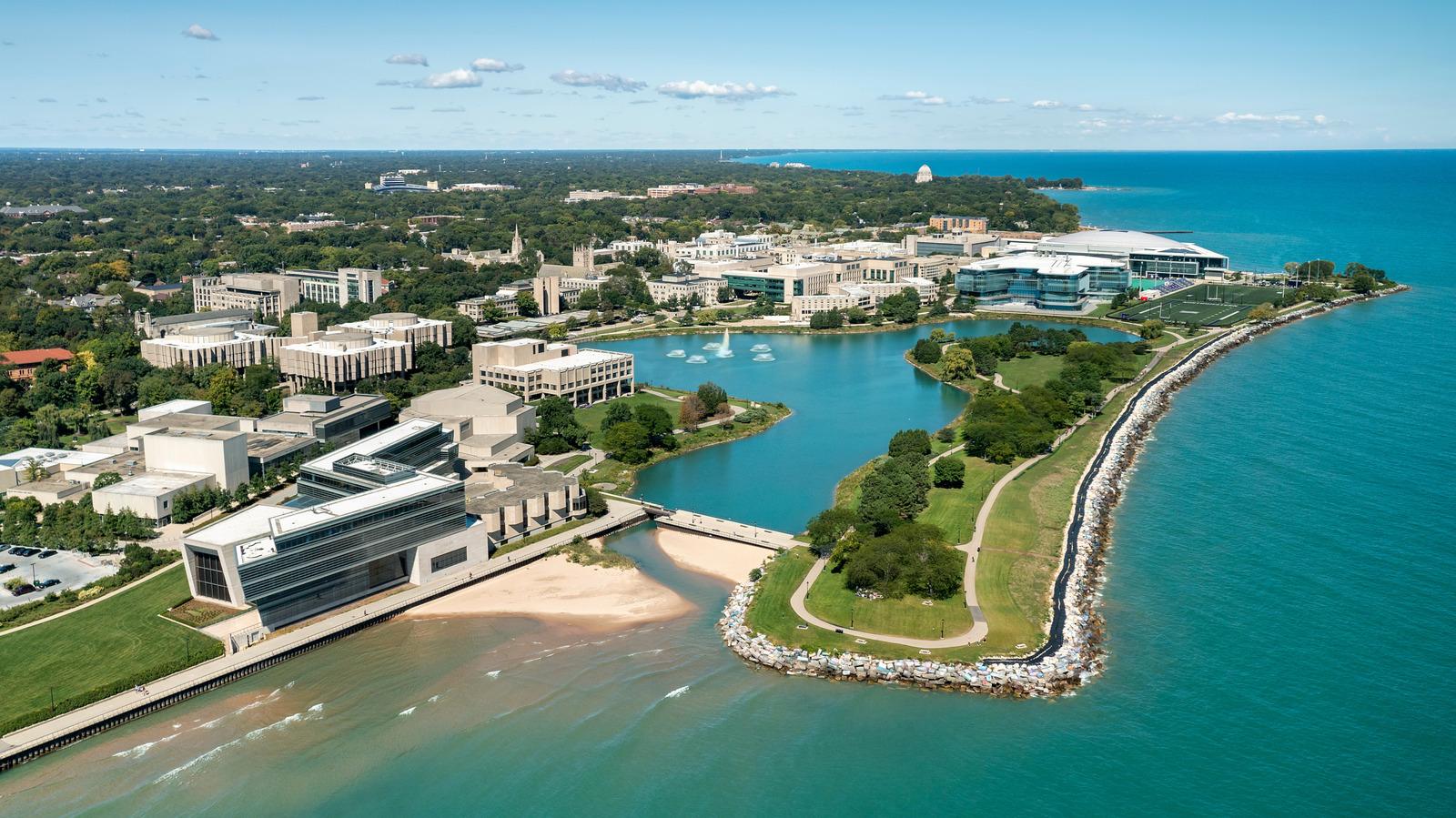
The Evanston campus sits along Lake Michigan, creating a university environment that feels both academic and naturally scenic. The campus encompasses approximately 240 acres and combines classrooms, laboratories, libraries, residence halls, performance spaces, athletic facilities, gardens, pathways, and lakefront areas.
Imagine walking to class beneath mature trees while the lake stretches beyond the campus. On a warm afternoon, students can gather near the lakefront, study outdoors, exercise, meet friends, or simply take a break from academic responsibilities.
The setting creates a different rhythm from universities located entirely within dense urban environments.
Evanston itself contributes to that atmosphere. Northwestern describes the city as a walkable college town with beaches, mature trees, historic homes, business districts, and a downtown area. At the same time, Chicago is close enough to provide the energy and opportunities of a major metropolitan area.
This creates a particularly appealing combination.
Students can enjoy the relative calm of a traditional college environment without giving up access to a major city. 🚆🌆
The lakefront also gives campus life a strong visual identity. During warmer months, students may spend time outside between classes, while colder seasons transform the landscape into something completely different. The changing environment can make the campus feel new again each year.
For prospective students, the physical environment can be an important part of the decision-making process. A university is not simply a collection of classrooms. It is the place where students will spend several formative years of their lives.
At Northwestern, the lake, architecture, gardens, and surrounding community all become part of that experience.
Academics Designed for Exploration 📚💡
Academic flexibility is one of Northwestern’s defining characteristics.
The university has 12 schools and colleges, offering undergraduate, graduate, and professional education across a wide range of disciplines. Its academic programs span areas including arts and sciences, communication, engineering, education, management, medicine, law, music, journalism, and professional studies.
This breadth matters because modern problems rarely fit neatly inside one academic department.
Consider a challenge such as climate change. Understanding it might require environmental science, engineering, economics, political science, communication, data analysis, and public policy. A university with strong connections between disciplines can give students opportunities to approach such problems from multiple perspectives.
Northwestern emphasizes this interdisciplinary approach.
According to university information, undergraduate students have access to thousands of courses each year, while many students combine multiple areas of study.
That creates opportunities for students who do not want their education to be limited to a single academic identity.
A student interested in computer science might also explore philosophy. Someone studying journalism might investigate data science. A musician could explore psychology or technology. An engineering student could become involved in entrepreneurship or design.
These combinations can encourage students to ask better questions.
Instead of thinking, “What is my major?” students can begin asking, “What problems do I want to understand?”
That change in perspective can be powerful. 🌱
Weinberg College of Arts and Sciences
The Weinberg College of Arts and Sciences provides a broad liberal arts education covering humanities, social sciences, natural sciences, mathematics, and related interdisciplinary fields.
The liberal arts model encourages students to develop analytical skills while exploring different ways of understanding the world.
McCormick School of Engineering and Applied Science
Engineering at Northwestern combines technical knowledge with creativity and problem-solving. Engineering education is increasingly connected with computing, design, entrepreneurship, materials, biomedical applications, and other fields.
The goal is not simply to understand how existing technologies work. It is also to imagine what technologies might come next. ⚙️🤖
School of Communication
Communication is another area in which Northwestern has developed a distinctive academic identity.
Students can explore theater, film, performance, dance, communication sciences, and other forms of human expression. Such programs demonstrate that communication is not merely about transmitting information. It is also about storytelling, culture, creativity, persuasion, and human connection.
Medill School of Journalism, Media, and Integrated Marketing Communications
In an era of social media, artificial intelligence, streaming platforms, podcasts, digital publications, and constantly changing information ecosystems, journalism and media education have become increasingly complex.
Students interested in media can explore reporting, storytelling, strategic communication, digital media, and emerging technologies while being connected to Chicago’s enormous media environment.
Bienen School of Music
Music students can develop their abilities in performance, composition, musicology, music education, theory, cognition, and related areas.
The presence of a major music school adds another dimension to Northwestern’s intellectual and creative ecosystem. 🎶
Kellogg School of Management
Management education adds another important component, connecting business knowledge with leadership, strategy, entrepreneurship, finance, marketing, organizational behavior, and innovation.
Together, these schools demonstrate why interdisciplinary study is such an important part of Northwestern’s identity.
Research and Innovation: Turning Questions Into Discovery 🔬🚀
A major research university should encourage students and faculty to ask questions for which there are not yet easy answers.
Northwestern has more than 90 school-based centers and 20 university research centers, according to its official facts and figures. Research areas include neuroscience, nanotechnology, biotechnology, drug discovery, data analytics, artificial intelligence, sustainability, and many other fields.
Research is important because it transforms education from passive learning into active discovery.
Reading about an experiment is valuable. Designing one can be transformative.
Studying an economic theory is useful. Testing how that theory applies to a real community can make the concept more meaningful.
Learning about artificial intelligence is interesting. Building a system that addresses a real-world problem can turn abstract knowledge into practical experience.
Northwestern’s research culture creates opportunities for students to become participants in this process.
The university’s current strategic priorities also emphasize areas such as biosciences, renewable energy and decarbonization, data analytics and artificial intelligence, interdisciplinary social sciences and global studies, and the creative and performing arts.
These priorities reflect a broader reality: the most important challenges facing society are interconnected.
Technology affects society.
Science affects policy.
Art influences culture.
Business affects sustainability.
Education affects opportunity.
Healthcare depends on science, technology, communication, economics, and human relationships.
A university capable of connecting these areas can provide students with a broader intellectual toolkit.
Chicago: A Classroom Beyond the Classroom 🏙️✨
One of Northwestern’s greatest advantages is its relationship with Chicago.
The Evanston campus is approximately 13 miles from Northwestern’s Chicago campus, and students can travel between the campuses using public transportation or the university’s intercampus shuttle.
Chicago itself becomes an extension of the university environment.
For students studying journalism, the city provides exposure to media organizations and diverse communities. For business students, Chicago is a major center of commerce and finance. For artists, it offers museums, theaters, galleries, music venues, and cultural institutions. For students interested in public policy or social sciences, the city provides countless opportunities to observe how urban systems work.
The Chicago campus is located in the Streeterville neighborhood and has a long history connected with Northwestern’s professional and medical education. The university acquired land there in 1921 as it expanded facilities for medical, dental, law, and business education.
Today, the Chicago campus supports a wide range of academic and research activities.
This connection between Evanston and Chicago is one of Northwestern’s most distinctive characteristics.
Students can have the traditional college experience while remaining closely connected to a global city.
That means a weekend does not have to be limited to campus.
Students can explore neighborhoods, restaurants, architecture, museums, concerts, sports, festivals, theaters, parks, and countless other attractions.
Chicago becomes part of the educational experience—not necessarily through formal assignments, but through exposure.
Exposure to different people.
Different cultures.
Different professions.
Different ideas.
Different ways of living.
And sometimes, simply different food. 🍕🌮🍜
Student Life: Finding Community at Northwestern 💜🐾
University life is not defined only by grades.
Students also need friendships, communities, traditions, activities, and experiences that make campus feel like home.
Northwestern has hundreds of student organizations covering academic interests, recreation, culture, performance, service, activism, and other areas. The university currently highlights more than 400 student organizations and 19 varsity sports.
This variety allows students to create experiences beyond their formal academic programs.
Someone who spends the morning studying physics could spend the evening rehearsing with a performance group.
A student focused on economics might participate in a community service organization.
A future journalist might join a campus publication.
An aspiring entrepreneur might work with an innovation organization.
These activities help students develop skills that are difficult to obtain solely through lectures.
Leadership.
Communication.
Teamwork.
Time management.
Creativity.
Resilience.
Collaboration.
Student organizations can also create a sense of belonging. When students find people who share their interests, the university becomes less about navigating a huge institution and more about participating in a smaller community within it.
Northwestern Traditions 🎉
Traditions help transform a university from a collection of buildings into a community with a shared identity.
One famous Northwestern tradition is painting “The Rock,” a large boulder that has been used by student groups since the 1940s to promote events, activism, and philanthropy.
Another tradition is March Through the Arch, in which incoming first-year and transfer students pass through the iconic Weber Arch.
Then there is Dillo Day, a student-run music festival on the lakefront that has grown from its original “Armadillo Day” roots into a major Northwestern tradition. 🎸🎤
Dance Marathon is another long-standing tradition, bringing students together for an extended fundraising event supporting charitable causes. According to Northwestern’s history page, the event has raised $23 million since 1975.
The Waa-Mu Show adds another artistic tradition. It is an original musical written and performed by Northwestern students and has existed for nearly a century.
These traditions illustrate something important about university culture: students do not merely inherit campus traditions—they continue to reshape them.
Athletics and the Wildcat Spirit 🐾🏆
Northwestern athletics are another important component of campus identity.
The university is a founding member of the Big Ten Conference and sponsors 19 intercollegiate varsity sports. Northwestern also supports club and intramural athletics, giving students multiple ways to participate in sports and recreation.
The Wildcat identity creates a shared language across campus.
Game days can bring students, alumni, faculty, and supporters together.
But athletics at Northwestern are connected with academic life as well. The university emphasizes academic achievement among student-athletes, and its athletics programs have produced national and conference success.
For many students, sporting events become social experiences rather than simply athletic competitions.
Friends gather.
School colors appear everywhere.
Music plays.
Fans cheer.
And campus feels different.
That collective energy is part of what makes residential university life memorable. 🏟️💜
Global Perspectives and Northwestern in Qatar 🌍
Northwestern’s identity extends beyond Illinois.
The university operates a campus in Doha, Qatar, while maintaining international partnerships and global academic initiatives. Northwestern’s global information highlights thousands of international students and scholars, international partnerships, and significant student participation in study-abroad experiences.
This global dimension matters in a world where professional and academic careers increasingly cross national boundaries.
Students may eventually work with colleagues from different countries, serve international organizations, conduct research across borders, or address problems that affect multiple societies.
International exposure can help students become more comfortable with complexity.
A global perspective does not mean simply traveling to another country.
It means learning to recognize that different societies can approach the same problem in different ways.
What works in Chicago might not work in another region.
A healthcare strategy developed in one country might need substantial adaptation elsewhere.
A communication campaign may need to reflect cultural context.
A business strategy can be affected by local regulations and traditions.
A global university environment gives students opportunities to think about those differences.
The Importance of Belonging and Community 🤝
Academic excellence matters, but students also need an environment where they feel connected.
Northwestern’s stated priorities include strengthening community, supporting students’ sense of belonging, promoting access and opportunity, encouraging engagement across differences, and supporting academic freedom and free expression.
Belonging can take many forms.
For one student, it may come from a residence hall.
For another, it may come from a cultural organization.
Someone else may find community through a laboratory, athletic team, theater production, music ensemble, or research project.
The important thing is that students can build multiple layers of community.
University life can sometimes feel overwhelming because students are surrounded by talented people with different ambitions. Yet that diversity can also be one of the most valuable aspects of the experience.
Students encounter perspectives they might never have encountered otherwise.
They learn to disagree.
They learn to collaborate.
They learn to explain their ideas.
They learn to listen.
And ideally, they learn that intellectual growth often happens when someone challenges an assumption they previously considered obvious.
Preparing Students for a Changing World 🌎💻
The world today’s students will enter after graduation may look very different from the world that exists today.
Artificial intelligence is changing workplaces.
Climate change is creating new challenges.
Healthcare is becoming increasingly technology-driven.
Digital media is transforming how people communicate.
Global economies are becoming more interconnected.
Businesses increasingly value adaptability alongside technical expertise.
In such an environment, education should not simply prepare students for one job title.
It should help them develop the ability to learn continuously.
Northwestern’s emphasis on interdisciplinary education is especially relevant here.
A student might graduate with knowledge in one primary field, but their professional life could require them to collaborate across several others.
An engineer may need communication skills.
A journalist may need data literacy.
A business leader may need knowledge of sustainability.
A scientist may need to communicate with policymakers.
A designer may need to understand artificial intelligence.
The boundaries between professions are becoming less rigid.
Northwestern’s combination of academic breadth, research, creative programs, professional education, and urban connections can therefore provide a useful foundation for an uncertain future.
Financial Aid and Access to Education 💰🎓
For many families, the question of affordability is just as important as academic quality.
Northwestern states that its undergraduate financial aid commitment is designed to meet 100% of demonstrated financial need. The university reported awarding more than $250 million in scholarships during the 2024–25 academic year.
This reflects an important principle: educational opportunity should not be determined solely by a family’s financial resources.
Understanding financial aid requires students and families to look beyond the published tuition figure.
The actual cost of attending a university can include housing, food, books, transportation, personal expenses, and other costs. Financial aid packages can significantly change what an individual family ultimately pays.
Prospective students should therefore research official financial aid policies carefully, complete required applications, and compare financial aid offers rather than relying only on advertised tuition numbers.
The Northwestern Experience Is More Than a Degree 🎓✨
At the end of the day, the value of a university cannot be reduced to rankings or statistics.
A degree is important, but the experience surrounding that degree can be equally significant.
At Northwestern, that experience may include walking beside Lake Michigan after a difficult exam.
It may include staying late in a laboratory because an experiment finally worked.
It may mean performing on stage in front of hundreds of people.
It may involve debating an idea with a professor.
It may mean discovering a career interest through an internship in Chicago.
It may be joining a student organization and eventually becoming its leader.
It may be watching the campus change with the seasons.
Or it may simply be sitting with friends somewhere on campus and realizing that the people around you have become an important part of your life. 💜
These moments are difficult to measure.
They do not appear neatly in a university ranking.
But they are often what graduates remember most.
Why Northwestern Continues to Stand Out 🌟
Northwestern’s distinctive character comes from the interaction of several strengths.
It is a research university with a strong interdisciplinary culture.
It has a beautiful lakefront campus.
It is closely connected to Chicago.
It has a global presence.
It offers programs spanning science, engineering, humanities, communication, journalism, business, music, law, medicine, education, and more.
It provides numerous opportunities for research, creative work, student organizations, athletics, and experiential learning.
And it has traditions that connect generations of students.
The university currently reports three campuses, 12 schools and colleges, approximately 21,000 enrolled students, more than 3,300 full-time faculty members, and more than 500 student organizations and clubs.
Those numbers help illustrate the scale of the institution, but the most interesting feature is how students can create a more personal experience within that scale.
A student can belong to a major university while simultaneously becoming part of a small research team, performance group, residence community, club, athletic team, or circle of friends.
That balance between breadth and intimacy is one of the most compelling aspects of Northwestern.
Looking Toward the Future 🚀
Northwestern’s next chapter will likely be shaped by many of the forces influencing higher education worldwide.
Artificial intelligence will change research and teaching.
New scientific discoveries will create opportunities and ethical questions.
Climate and sustainability challenges will require interdisciplinary solutions.
Global connections will become increasingly important.
Creative industries will continue evolving alongside new technologies.
And students will increasingly need to combine specialized expertise with adaptability.
Northwestern’s stated priorities already reflect many of these challenges, including biosciences, sustainability, artificial intelligence and data analytics, interdisciplinary global studies, the creative arts, and the educational experience.
The future of the university will therefore not simply be about preserving what already works.
It will be about continuing to experiment.
That spirit connects the present to the institution’s original history.
The founders of Northwestern could not have predicted the technologies, professions, research fields, or global challenges of the twenty-first century.
But they understood something enduring: education has the power to shape generations.
Final Thoughts: A Place for Curiosity, Ambition, and Possibility 💜🎓
Northwestern University represents a distinctive blend of academic ambition, research, creativity, community, tradition, and place.
Its Evanston campus offers the beauty of Lake Michigan and the atmosphere of a college town. Its Chicago presence connects students to a major international city. Its Doha campus and global partnerships extend that experience internationally.
Its academic structure encourages students to explore across disciplines rather than seeing knowledge as a collection of isolated subjects.
Its research culture provides opportunities to move from questions toward discovery.
Its student organizations and traditions create spaces for friendship, leadership, creativity, and service.
And its long history provides a foundation upon which new generations can build.
For a prospective student, Northwestern may be attractive because it offers many different versions of university life at once.
You can be a researcher.
An artist.
An athlete.
An entrepreneur.
A journalist.
An engineer.
A musician.
A scientist.
A communicator.
A leader.
Or, perhaps most importantly, a student still figuring out what you want to become.
That final possibility is worth remembering.
University is not supposed to provide every answer before you arrive.
It is supposed to give you the tools, experiences, communities, challenges, and opportunities that help you discover better questions.
And in that sense, Northwestern’s greatest strength may be its ability to create an environment where curiosity can become action.
Where ideas can become research.
Where creativity can become expression.
Where friendships can become community.
And where education can become a foundation for lifelong discovery. 🌎✨
For students who value intellectual exploration, interdisciplinary learning, research, creativity, and an energetic connection to both campus and city life, Northwestern offers a remarkable setting in which to begin that journey.
The Wildcat experience is ultimately more than a campus, more than a collection of schools, and more than a degree.
It is an invitation to explore what is possible.