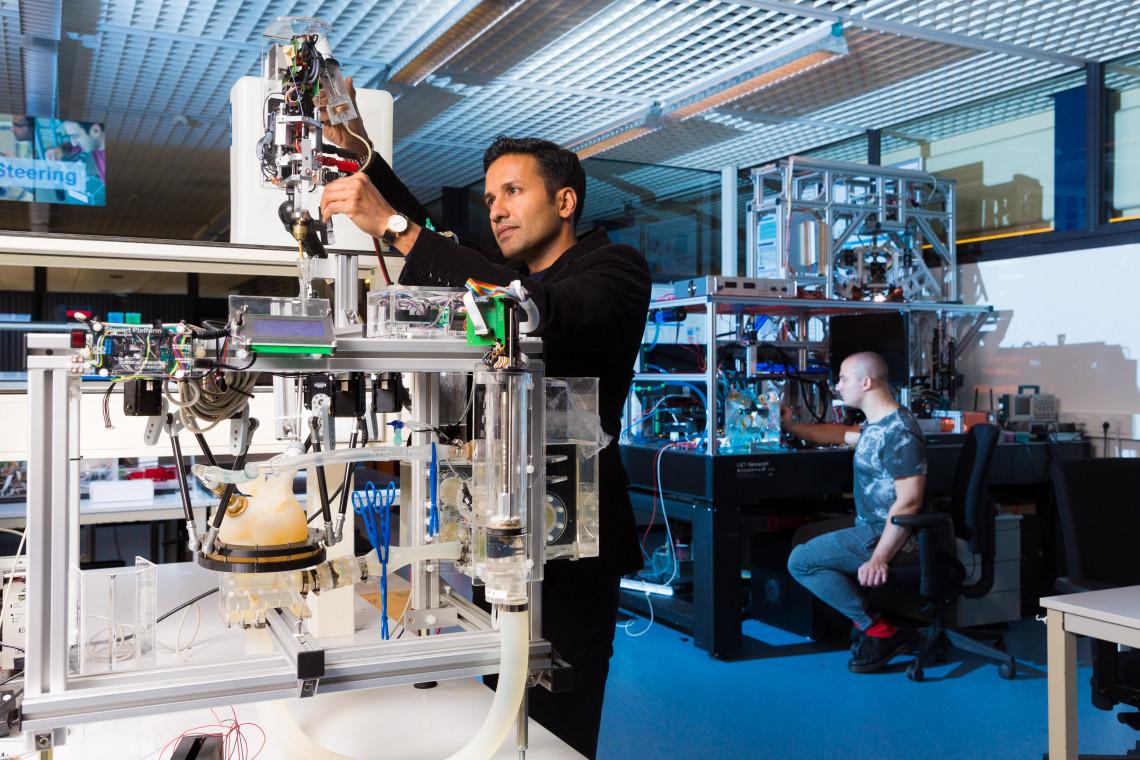
Labs: our rich learning environments in the city | Research | AUA
Meta description: IIT Kharagpur plans to establish the Benjamin Gupta School of Physical AI with a ₹35 crore investment, bringing together artificial intelligence, robotics, computational engineering, scientific research, and interdisciplinary education.
Related tags: IIT Kharagpur, Physical AI, Artificial Intelligence, Robotics, Computational Engineering, AI Education, Indian Institutes of Technology, Machine Learning, Autonomous Systems, Scientific AI, Digital Twins, Engineering Education, Higher Education India, AI Research, Technology Innovation, Healthcare Technology, Smart Manufacturing, AI Careers, Research and Development, Future of Education
Introduction: Taking Artificial Intelligence Beyond the Screen 🤖
Artificial intelligence has transformed the way people communicate, work, study, and solve problems. From conversational assistants and image-generation tools to predictive analytics and automated software development, AI has become an increasingly important part of the digital economy. Yet the next phase of its development may extend far beyond screens, applications, and online services.
The Indian Institute of Technology Kharagpur (IIT Kharagpur) is preparing to take a major step in this direction with the establishment of the Benjamin Gupta School of Physical AI. Announced on October 26, 2026, the initiative is planned with a total investment of ₹35 crore and aims to bring artificial intelligence together with physics, engineering, biological sciences, and practical experimentation. Press Information Bureau+1
The proposed school is intended to become India’s first dedicated academic institution focused on Physical AI. Unlike conventional AI applications that primarily analyze digital information, Physical AI aims to develop intelligent systems that understand and interact with real-world environments.
This means exploring how machines can respond to changing physical conditions, how engineering systems can use scientific models to make better predictions, and how intelligent technologies can operate more reliably in environments where safety and accuracy matter.
The initiative reflects a broader shift in technology education. Future engineers and scientists may need more than knowledge of algorithms and programming. They will also need to understand the physical principles, materials, biological systems, and operational constraints that shape the problems AI is expected to solve.
For students, researchers, professionals, and industries, IIT Kharagpur’s announcement offers an important glimpse into how India’s AI education landscape may evolve.
1. Understanding Physical AI and Why It Matters 🌐
Physical AI refers to approaches that connect artificial intelligence with the physical world. It combines data-driven learning with scientific knowledge, sensors, engineering models, and control systems to help intelligent technologies operate in real environments.
Traditional AI systems can be highly effective at identifying patterns in text, images, and numerical information. However, a machine operating in the physical world must deal with additional challenges, including gravity, friction, temperature, changing materials, uncertain measurements, and mechanical limitations.
A robot working in a manufacturing facility, for example, cannot rely only on recognizing objects through a camera. It must also understand how its movements affect surrounding equipment, how much force is appropriate, and how to respond if an object shifts unexpectedly.
Similarly, an AI system used to support engineering design must account for the physical properties of materials and the operating conditions of the structure being developed.
From Digital Intelligence to Real-World Interaction
Physical AI seeks to connect intelligent computation with these real-world requirements.
A system may use machine learning to recognize patterns, physics-based models to estimate how a structure will behave, and sensors to compare predictions with actual measurements. Control algorithms can then help the system adjust its behavior as conditions change.
This approach can be valuable wherever AI must interact with physical objects or influence processes in the real world.
Examples include:
- Industrial robots that adapt to changing production conditions.
- Autonomous systems that interpret their surroundings and plan movements.
- Digital twins that simulate the behavior of physical equipment.
- Agricultural technologies that help monitor crops and optimize resources.
- AI-assisted medical devices that combine sensor information with scientific and clinical knowledge.
These examples illustrate potential applications of the field; they are not a claim that the proposed IIT Kharagpur school has already developed or deployed each technology.
Why Scientific Knowledge Is Essential
AI predictions are not automatically correct simply because they are generated by sophisticated models.
An engineering system may produce an output that appears statistically plausible but violates a physical constraint. A medical model may identify a pattern without adequately accounting for biological or clinical context.
By integrating scientific knowledge into AI development, researchers can investigate whether predictions remain consistent with established principles and whether systems behave reliably under unfamiliar conditions.
This does not eliminate uncertainty. Physical models can also be incomplete, and measurements may contain errors. The goal is to combine different forms of evidence so that AI systems can be evaluated more rigorously.
IIT Kharagpur’s proposed school is built around this interdisciplinary approach, with an emphasis on connecting intelligent computation to the systems it is designed to influence. Press Information Bureau+1
2. The ₹35 Crore Investment Behind the New School 💰
One of the most notable aspects of the initiative is its planned financial commitment. IIT Kharagpur has announced a total investment of ₹35 crore to support the Benjamin Gupta School of Physical AI and associated academic and research activities.
The funding combines philanthropic contributions with institutional support, reflecting the role that alumni and educational foundations can play in developing advanced research infrastructure.
Funding breakdown
Planned investment: ₹35 crore
Vinod Gupta family
₹12.5 crore
35.7% of the planned investment
Anonymous alumnus
₹10 crore
28.6% of the planned investment
IIT Kharagpur
₹12.5 crore
35.7% of the planned investment
Source: Government of India’s Press Information Bureau, October 26, 2026. Press Information Bureau+1
The Contribution of Alumni Philanthropy
The Vinod Gupta family has committed ₹12.5 crore, while another alumnus who wishes to remain anonymous is contributing ₹10 crore. IIT Kharagpur will provide the remaining ₹12.5 crore. Press Information Bureau+1
The funding model demonstrates how collaboration between an educational institution and its alumni network can support new academic priorities.
Advanced research often requires specialized equipment, computing resources, laboratories, interdisciplinary teams, and sustained institutional investment. Financial support can help create the infrastructure needed to bring researchers together and develop practical applications.
The actual impact will depend on how effectively the planned investment is converted into research facilities, teaching opportunities, and collaborative projects.
A Memorial That Supports Scientific Advancement
The school will be named the Benjamin Gupta School of Physical AI in memory of Benjamin Gupta, the late son of philanthropist and IIT Kharagpur alumnus Vinod Gupta.
The naming gives the initiative a personal dimension while connecting that legacy with education, scientific advancement, and potential societal benefits. Press Information Bureau+1
Beyond its financial contribution, the initiative reflects an important principle in higher education: long-term investment in research can create opportunities for future generations of students, scientists, and engineers.
3. Research Priorities: Robotics, Digital Twins, and Computational Engineering ⚙️
The proposed school will bring together several connected fields rather than focus on a single branch of artificial intelligence.
According to the institute’s announcement, its research agenda is expected to include physics-informed machine learning, scientific AI, digital twins, intelligent robotics, autonomous systems, advanced sensing, and AI-enabled experimentation. Press Information Bureau+1
Civil and Mechanical Engineering — Malla Reddy (MR) Deemed to be University
Digitale Zwillinge überwachen, lernen und optimieren in Echtzeit | TU Wien
9
Physics-Informed Machine Learning
Physics-informed machine learning combines data-driven algorithms with mathematical descriptions of physical processes.
In many scientific problems, researchers have access to both experimental measurements and established physical laws. Integrating the two can help build models that produce predictions consistent with known constraints.
For example, engineers studying heat transfer may use physical equations alongside sensor data to estimate temperature patterns in a complex system. A model that incorporates relevant scientific relationships may be easier to validate than one that relies exclusively on statistical correlations.
This approach can also be useful when experimental data is limited or expensive to collect. However, the quality of the result depends on the assumptions, measurements, and physical models used.
Scientific Artificial Intelligence
Scientific AI focuses on applying artificial intelligence to scientific discovery and complex research problems.
Researchers may use AI to analyze experimental results, explore large sets of possible designs, identify patterns in observations, or develop hypotheses that can be tested in laboratories.
Potential applications include materials research, energy technology, environmental modeling, and biological sciences.
The important distinction is that AI-generated hypotheses still require scientific verification. A model can suggest a promising direction, but experiments and independent analysis are needed to establish whether its predictions are correct.
Digital Twins and Computational Engineering
A digital twin is a digital representation of a physical object, process, or system. Depending on its design, it may combine engineering models, operational data, sensor measurements, and simulation tools.
For example, a digital twin of an industrial machine could help engineers estimate wear, compare operating conditions, and investigate how changes in temperature or workload affect performance.
Computational engineering uses numerical methods and computer-based simulations to study engineering systems that may be difficult or expensive to test physically.
When combined with AI, these methods could help researchers explore more design alternatives, identify unusual operating conditions, and improve maintenance planning.
The school’s proposed focus on these areas could create opportunities for interdisciplinary projects linking computer science with mechanical, electrical, civil, and other engineering disciplines.
Intelligent Robotics and Autonomous Systems
Robotics combines sensing, movement, control, and decision-making. Autonomous systems add the ability to perform certain tasks with limited direct human intervention.
An intelligent robot may need to identify objects, plan a movement, estimate distances, and adjust its actions when the environment changes. Its decisions must also account for physical constraints and the safety of people nearby.
This makes robotics a natural application area for Physical AI.
The research challenge is not merely to create machines that can perform a task under ideal conditions. It is to develop systems that respond predictably when conditions are uncertain and recognize when human intervention is required.
4. How the School Could Transform AI Education in India 🎓
Research is only one part of IIT Kharagpur’s plan. The institute also intends to use the school to develop educational opportunities that combine AI with students’ existing expertise in engineering, physical sciences, life sciences, and medicine.
Academic programmes are expected to begin in the upcoming academic session, subject to the necessary approvals. Proposed offerings include hybrid-mode master’s programmes, executive education, professional certifications, and specialized interdisciplinary learning modules. Press Information Bureau+1
These are planned offerings rather than confirmed admissions opportunities. Prospective students should wait for official announcements about course structures, eligibility, fees, application deadlines, and approvals.
Learning AI Through Practical Problems
Traditional academic programmes often teach subjects through a sequence of theoretical concepts, mathematical foundations, and specialized coursework. These remain essential, but Physical AI also requires students to understand how different fields interact in real applications.
An interdisciplinary project might ask students to design a robotic system that handles objects of different shapes and materials.
Such a project could involve computer vision, machine learning, mechanics, sensors, control engineering, and experimental testing. Students would need to understand not only how to train a model but also how the robot behaves when its predictions are incorrect.
Similarly, a computational engineering project could combine numerical simulation with AI to investigate the performance of a mechanical structure under changing conditions.
This style of learning can help students connect abstract concepts with practical engineering decisions.
Hybrid Learning and Flexible Education
Hybrid education combines online learning with selected in-person activities, laboratory work, or collaborative sessions.
If implemented effectively, this model could make advanced learning more accessible to working professionals who cannot attend campus full-time.
An engineer employed in manufacturing might want to learn how AI can improve quality control. A scientist could explore machine learning methods for analyzing experimental data. A medical professional might seek a better understanding of AI-assisted diagnostics and clinical decision support.
The proposed school aims to address learners from these different backgrounds through specialized and interdisciplinary education. Press Information Bureau+1
The practical value of these programmes will depend on curriculum quality, teaching support, hands-on experience, and how well the learning outcomes match professional needs.
Connecting Theory With Industry Requirements
Employers increasingly need people who can apply AI within the constraints of a particular industry.
A manufacturing engineer must understand production processes. A healthcare specialist must understand clinical workflows and patient safety. An energy researcher must understand the physical systems involved in electricity generation, storage, and distribution.
The proposed school seeks to help learners combine this existing domain knowledge with contemporary AI capabilities.
That approach may help bridge the gap between professionals who understand a particular field and specialists who build AI models.
It could also encourage collaboration among students who bring different perspectives to the same problem, making education more relevant to complex real-world applications.
5. Potential Applications Across Healthcare, Agriculture, Energy, and Manufacturing 🏥🌱
One reason Physical AI is attracting attention is its potential relevance to industries where decisions have direct consequences in the physical world.
IIT Kharagpur has identified advanced manufacturing, energy systems, climate and environmental technologies, agriculture, healthcare, medical devices, and intelligent infrastructure as areas where the school’s research could contribute. Press Information Bureau+1
These are potential research and application areas, not a guarantee that specific products or services will emerge immediately.
Ecology & Sustainability: 100 AI-Powered Business and Startup Ideas
ERC Proof of Concept-beurs voor Sarthak Misra – U-Today
Automated Manufacturing Companies: 2026 Technology Guide | Automate X
9
Advanced Manufacturing and Industrial Automation
Manufacturing facilities rely on accurate measurements, repeatable processes, and reliable equipment. Even a small defect in a production process can lead to wasted materials, delays, or costly quality problems.
AI systems can analyze sensor readings, identify unusual patterns, and support decisions about production quality. When combined with physical models and robotic control, these capabilities may help factories respond more effectively to changing conditions.
For example, an AI-assisted inspection system could identify a possible manufacturing defect, while engineering models help determine whether the deviation affects the product’s performance.
Robotic systems could also use sensors to adapt their movements when handling different objects.
However, industrial automation must account for worker safety, equipment limitations, and the consequences of incorrect decisions. Physical AI research could contribute to the development of systems that are more responsive and easier to evaluate.
Healthcare and Medical Technology
Healthcare is another area where combining AI with scientific knowledge is particularly important.
AI systems may assist with medical imaging, monitoring, laboratory analysis, and decision support. Physical AI could extend this work to medical devices and systems that interact directly with patients or clinical environments.
For example, a research team might investigate how sensor information and biomechanical models could support a rehabilitation device. Another project could explore how physical simulations and AI might improve the design of a medical instrument.
Any such application would require careful validation, clinical oversight, and compliance with applicable safety requirements. AI predictions should support qualified professionals rather than replace clinical judgment without appropriate evidence.
The school’s interdisciplinary model could encourage collaboration between computing specialists, engineers, researchers, and medical professionals.
Agriculture and Environmental Sustainability
Agriculture faces challenges involving water availability, changing weather conditions, soil quality, crop health, and the efficient use of resources.
AI-assisted sensing systems can help collect and interpret information about these conditions. Robotics and computational models may then support more targeted interventions.
A research project could explore a robot that identifies areas requiring irrigation or estimates crop conditions using multiple sensor inputs. Another could investigate physical and statistical models for understanding environmental changes.
Such applications would need to account for real-world variability, including uneven terrain, changing light, sensor errors, and unpredictable weather.
Physical AI may help connect predictive models with the practical constraints of agricultural work.
Energy and Intelligent Infrastructure
Energy systems and infrastructure operate under changing physical conditions. Power equipment experiences temperature variation, mechanical stress, and fluctuations in demand.
AI-assisted monitoring could help engineers identify unusual patterns and estimate when maintenance may be needed. Digital twins could support simulations of alternative operating conditions before engineers implement changes in physical systems.
Similar approaches could be explored for transportation infrastructure, industrial facilities, and water-management systems.
Because failures in these environments can affect public safety and essential services, reliability must be central to their design.
The value of Physical AI will therefore depend not only on predictive accuracy but also on the ability to explain, test, and safely control its outputs.
6. Preparing Students for Emerging AI Careers 💼
The establishment of a dedicated Physical AI school may also influence how students think about future careers.
AI-related work is not limited to software development or data science. As intelligent technologies become integrated with physical systems, opportunities may emerge across robotics, scientific computing, industrial automation, simulation, sensing, and engineering research.
The proposed school could provide an environment for learners to explore these intersections. Its actual contribution to employment and career development will depend on the quality of its programmes, research collaborations, and industry engagement.
Skills That May Become Increasingly Valuable
Students interested in Physical AI can begin developing a broad technical foundation before specialized programmes become available.
Useful areas of study include:
- Programming: Python and other languages used for scientific computing and automation.
- Mathematics: Linear algebra, calculus, probability, statistics, and optimization.
- Machine learning: Model training, evaluation, uncertainty, and data preparation.
- Physics and engineering: Mechanics, dynamics, materials, electronics, and control systems.
- Robotics: Sensors, motion planning, feedback control, and embedded computing.
- Simulation: Numerical methods, computational modeling, and digital-twin concepts.
- Safety and ethics: Reliability, privacy, human oversight, and responsible system design.
Not every learner needs to master all these subjects at once. A student studying mechanical engineering may begin with robotics and control, while someone from computer science may explore physics-informed modeling and simulation.
The central advantage comes from understanding how different technical disciplines complement one another.
Interdisciplinary Learning Can Broaden Career Options
A computer scientist who understands engineering constraints may be better equipped to collaborate on industrial automation. An engineer who can evaluate machine-learning models may be able to contribute to intelligent manufacturing systems.
Similarly, a scientist with computational skills may use AI to investigate research questions that would otherwise require extensive manual analysis.
These combinations can help professionals work across traditional departmental boundaries.
However, a new academic school does not guarantee a specific job, salary, or employment outcome. Students should assess the actual curriculum, practical opportunities, faculty expertise, and industry connections when deciding whether a programme suits their goals.
Advice for Prospective Applicants
Students interested in the Benjamin Gupta School of Physical AI should follow official IIT Kharagpur announcements for information about programme launches and admission requirements.
Since the academic offerings are proposed and remain subject to approvals, prospective applicants should not assume that a particular degree, course duration, or admission route has already been finalized. Press Information Bureau+1
In the meantime, learners can strengthen their mathematics and programming foundations, complete small robotics or simulation projects, and explore introductory AI courses.
Building a portfolio of practical work can help students understand whether they prefer software development, physical engineering, scientific research, or a combination of these areas.
7. The Role of Industry Partnerships and Collaborative Research 🤝
Advanced AI development often requires resources and expertise that no single department can provide independently.
A robotics project may need machine-learning researchers, mechanical engineers, electronics specialists, and experts in safety testing. A healthcare technology project may also require clinical knowledge, regulatory guidance, and access to appropriate research environments.
IIT Kharagpur’s proposed school aims to create connections among academia, industry, healthcare institutions, research laboratories, startups, and international partners. Press Information Bureau+1
Turning Research Into Practical Solutions
University research can produce new methods and prototypes, but translating them into practical technologies requires additional work.
A laboratory model must be tested under realistic conditions. Engineers must determine whether it remains reliable when measurements are noisy or the environment changes. Organizations may also need to assess manufacturing costs, maintenance requirements, and safety implications.
Industry partnerships can help researchers understand these constraints earlier in the development process.
Companies may contribute practical problems, operational expertise, equipment access, or opportunities to evaluate prototypes. Academic researchers can contribute scientific methods and independent investigation.
Well-designed partnerships can create a productive exchange between research and industry, although their success depends on clear objectives, responsible data sharing, and appropriate evaluation.
Supporting Startups and Innovation
Physical AI could also create opportunities for startups developing robotics systems, industrial inspection tools, scientific software, or specialized AI-enabled devices.
Academic environments can support innovation by helping researchers test ideas, build prototypes, and collaborate with technical experts.
However, moving from a promising demonstration to a commercially viable product can take time. Startups must consider reliability, cost, customer requirements, intellectual property, and regulatory obligations.
The school could help strengthen the research ecosystem around these challenges if its facilities, collaborations, and educational activities develop as intended.
Building Indigenous Technology Capabilities
India’s expanding digital economy creates opportunities to develop technologies suited to local industrial and societal needs.
Research into agriculture, manufacturing, healthcare, energy, and environmental systems could help address challenges that require an understanding of local operating conditions.
Developing reliable domestic expertise can also contribute to the broader innovation ecosystem by supporting specialized talent, research partnerships, and technology development.
The potential impact of the Benjamin Gupta School of Physical AI will ultimately depend on its ability to connect research excellence with practical needs and measurable outcomes.
8. Responsible AI: Why Reliability and Safety Must Come First 🔐
As artificial intelligence moves into physical environments, the consequences of errors can become more significant.
A chatbot may generate an inaccurate answer, but a robot operating near a person could cause physical harm if its control system fails. An engineering model may produce an incorrect prediction that influences a costly design decision. A medical device could create risks if its output is interpreted without sufficient clinical oversight.
These examples demonstrate why Physical AI must be developed with safety and accountability in mind.
Moving Beyond the Black Box
Some AI models produce predictions that are difficult to interpret. Even when their outputs appear accurate, users may not understand which factors influenced a particular result or how reliably the model will behave under unfamiliar conditions.
IIT Kharagpur’s stated vision emphasizes moving beyond AI as a black-box solution and combining algorithmic intelligence with fundamental scientific and domain-specific knowledge. Press Information Bureau+1
This approach could encourage researchers to examine the physical assumptions behind a model, test predictions against experimental evidence, and evaluate behavior across different operating conditions.
Explainability does not automatically make a system safe, and scientific models can contain errors. Nevertheless, transparent assumptions and independent validation can make it easier to identify limitations and determine when a system should not be trusted.
Human Oversight in Safety-Critical Applications
Physical AI systems should be designed around the consequences of failure.
In industrial environments, this may involve emergency stops, physical safety barriers, restricted operating zones, and independent monitoring. In healthcare, it may require clinical supervision and evidence that a device performs reliably for its intended purpose.
For autonomous systems, engineers should also consider what happens when sensors fail, communications are interrupted, or the environment differs from the model’s expectations.
The ability to stop safely is as important as the ability to perform a task successfully.
Ethical and Social Responsibility
Responsible AI development also requires attention to privacy, fairness, accessibility, and accountability.
AI systems that process health information must protect sensitive data. Technologies used in workplaces should be assessed for their effects on employees. Automated decisions that affect people should have appropriate oversight and avenues for review.
As the field develops, educational programmes will need to prepare students to recognize these issues alongside technical challenges.
The long-term success of Physical AI will depend not just on whether machines can interact with the world, but on whether those interactions are beneficial, dependable, and accountable.
9. What the Initiative Means for India’s Technology Future 🇮🇳
IIT Kharagpur’s proposed school represents a strategic investment in an emerging area of artificial intelligence.
The initiative brings together research, education, professional development, and potential industry applications under one interdisciplinary vision. Its focus on connecting AI with physical sciences and engineering could help prepare students for challenges that extend beyond conventional software development.
The ₹35 crore investment also signals an institutional commitment to developing infrastructure and supporting collaboration across technical disciplines. Press Information Bureau+1
Strengthening the Research Ecosystem
A dedicated academic environment can help researchers share equipment, compare methods, and develop projects that cross departmental boundaries.
For example, a team investigating autonomous agricultural machinery might combine computer vision, mechanical engineering, environmental data, and control systems. Another team could investigate digital twins for industrial equipment using computational modeling and operational measurements.
Such collaboration may help researchers tackle complex problems that would be difficult to address within a single discipline.
The effectiveness of the school will depend on the strength of its research teams, the quality of its infrastructure, and its ability to sustain productive collaborations over time.
Addressing the Skills Gap
The rapid expansion of AI has created demand for professionals who can do more than operate ready-made tools.
Organizations increasingly need people who understand the limitations of AI models, can integrate them with existing systems, and know how to evaluate their performance in real environments.
The proposed school aims to help students and working professionals combine their existing expertise with contemporary AI capabilities.
If its educational programmes are implemented effectively, they could contribute to the development of a workforce better prepared for interdisciplinary research and engineering.
Measuring Long-Term Success
The announcement is an important first step, but the school’s lasting impact will become clearer through its implementation.
Useful measures of progress could include the quality of its academic programmes, research outputs, industry collaborations, validated technologies, and opportunities for students and professionals.
It will also be important to assess whether the resulting technologies solve practical problems safely and economically.
A successful Physical AI school would not be defined only by its funding or facilities. Its significance would ultimately rest on the knowledge it generates, the people it trains, and the real-world problems its researchers help solve.
Conclusion: Building the Next Generation of Intelligent Engineering 🚀
IIT Kharagpur’s plan to establish the Benjamin Gupta School of Physical AI marks an important development in India’s technology education landscape. With a proposed investment of ₹35 crore, the initiative aims to connect artificial intelligence with robotics, computational engineering, scientific research, and the physical principles governing real-world systems.
The school is expected to explore areas including physics-informed machine learning, digital twins, autonomous systems, advanced sensing, and AI-enabled experimentation. Its planned educational offerings could also create new opportunities for students, researchers, and working professionals seeking to combine AI knowledge with expertise in engineering, physical sciences, life sciences, and medicine.
The broader significance lies in the shift from treating AI primarily as a digital tool to exploring how intelligent systems can operate reliably in physical environments.
This transition could influence manufacturing, healthcare, agriculture, energy, environmental research, and infrastructure. Yet the potential benefits will depend on rigorous scientific validation, responsible engineering, effective industry partnerships, and careful attention to safety.
The proposed school is still at the stage of establishment and programme planning, with academic offerings subject to the required approvals. Its long-term contribution will therefore depend on how effectively the announced vision becomes practical education and research.
For aspiring students, the development is a reminder that the future of AI will involve much more than coding and algorithms. Mathematics, physics, engineering, experimentation, and ethical judgment will remain essential to building dependable intelligent technologies.
IIT Kharagpur’s Physical AI initiative offers a compelling vision for the next phase of innovation: bringing artificial intelligence closer to the real world while ensuring that scientific understanding, human responsibility, and engineering reliability remain at the center of progress. 🌟
Related Tags
IIT KharagpurPhysical AIArtificial IntelligenceRoboticsComputational EngineeringAI EducationHigher Education IndiaMachine LearningAutonomous SystemsScientific AIDigital TwinsEngineering EducationAI ResearchTechnology InnovationIndian EducationHealthcare TechnologySmart ManufacturingAI CareersResearch and DevelopmentFuture of EducationPhysics-Informed AIIndustrial AutomationAI EthicsResponsible AIVinod GuptaBenjamin Gupta School of Physical AISTEM EducationAdvanced EngineeringDigital TransformationScience and Technology
For official details, see the Press Information Bureau announcement on the Benjamin Gupta School of Physical AI. Programme details and admissions should be confirmed through official IIT Kharagpur notices.