Introduction
Education is evolving rapidly, and one of the most exciting trends transforming classrooms is gamification. By incorporating game-like elements into learning experiences, educators can make lessons more interactive, enjoyable, and effective. Whether in schools, colleges, or online learning platforms, gamification motivates students to participate actively, develop critical thinking skills, and retain knowledge better.
In this article, we’ll explore what gamification is, its benefits, practical examples, challenges, and how it is shaping the future of education.
What Is Gamification in Education?
Gamification is the process of applying game mechanics and design principles to non-game environments, such as classrooms or online courses. Instead of simply reading textbooks or attending lectures, students engage in activities that reward progress and encourage participation.
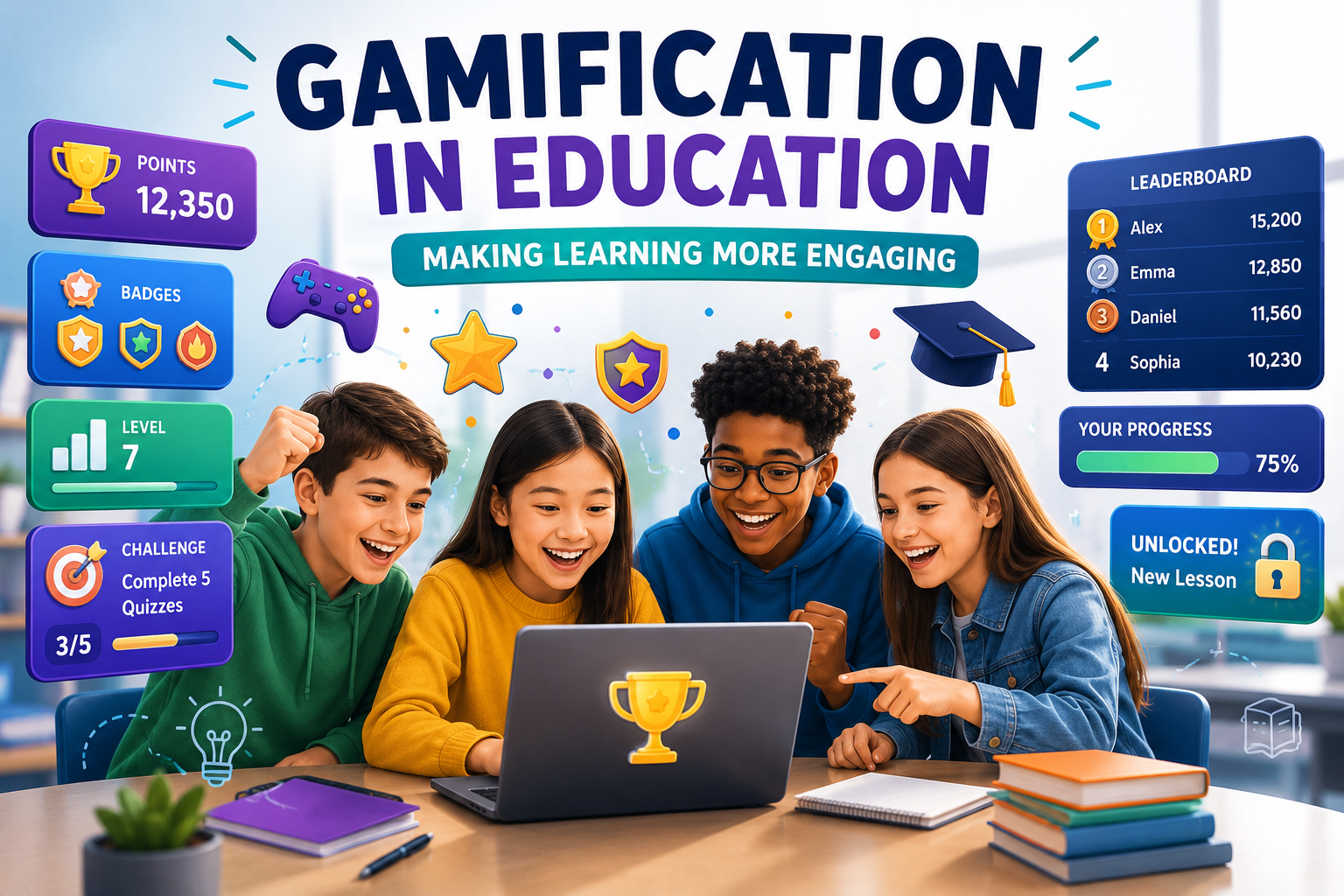
Common gamification elements include:
- 🏆 Points and scoring systems
- 🎖️ Badges and achievements
- 📈 Progress bars
- 🥇 Leaderboards
- 🎯 Challenges and missions
- ⭐ Rewards and certificates
- 🔓 Unlockable content
- ❤️ Instant feedback
These elements create a sense of accomplishment that keeps learners motivated.
Why Gamification Matters
Traditional teaching methods often struggle to maintain students’ attention. Today’s learners have grown up with technology, interactive media, and video games. Gamification bridges this gap by making learning feel more engaging and rewarding.
Key reasons gamification matters include:
- Increases student motivation
- Makes learning fun
- Encourages healthy competition
- Improves classroom participation
- Promotes consistent learning habits
- Reduces boredom
- Builds confidence through small achievements
Benefits of Gamification in Education
🎯 1. Increased Student Engagement
Interactive quizzes, competitions, and learning challenges encourage students to participate more actively than passive lectures.
Students become excited about completing lessons because each task offers rewards and recognition.
🧠 2. Better Knowledge Retention
Research suggests that active participation helps learners remember information longer.
Gamified learning encourages:
- Repetition
- Practice
- Immediate feedback
- Application of knowledge
These factors improve long-term memory.
🚀 3. Higher Motivation
Students enjoy achieving goals.
Simple rewards such as:
- Digital badges
- Experience points (XP)
- Level progression
- Certificates
give learners a sense of accomplishment.
🤝 4. Improved Collaboration
Many educational games require teamwork.
Students learn:
- Communication
- Leadership
- Problem-solving
- Collaboration
- Respect for others
These are valuable life skills.
📚 5. Personalized Learning
Gamified platforms allow students to progress at their own pace.
Advanced learners can tackle more difficult challenges while struggling students receive additional practice without feeling embarrassed.
💡 6. Encourages Problem-Solving
Many educational games involve puzzles and real-world scenarios.
Instead of memorizing answers, students learn how to think critically and solve problems independently.
Examples of Gamification in Education
🎮 Classroom Quizzes
Teachers use quiz platforms where students earn points for correct answers.
Examples include:
- Kahoot!
- Quizizz
- Blooket
🏅 Badge Systems
Students receive badges for:
- Completing homework
- Reading books
- Perfect attendance
- Helping classmates
- Excellent performance
📈 Level-Based Learning
Courses are divided into levels.
Students unlock:
- New lessons
- Advanced challenges
- Bonus materials
- Hidden content
after mastering previous topics.
🧩 Educational Escape Rooms
Teachers create puzzles related to subjects like:
- Mathematics
- Science
- History
- Geography
Students solve clues to “escape” within a time limit.
🌍 Virtual Simulations
Students explore realistic environments such as:
- Virtual laboratories
- Historical civilizations
- Space exploration
- Business simulations
These experiences make learning immersive.
Technology Driving Gamification
Modern educational technology has made gamification easier than ever.
Popular tools include:
- Learning Management Systems (LMS)
- AI-powered tutors
- Educational mobile apps
- Interactive whiteboards
- Augmented Reality (AR)
- Virtual Reality (VR)
- Adaptive learning platforms
Artificial intelligence also personalizes learning paths based on each student’s performance.
Gamification Across Different Subjects
Mathematics
Students solve puzzles to earn points and unlock higher levels.
Science
Virtual experiments reward successful observations and discoveries.
Language Learning
Apps reward vocabulary practice with streaks, badges, and daily goals.
History
Interactive storytelling lets students experience historical events through role-playing.
Coding
Programming platforms transform coding lessons into adventure games.
Role of Teachers
Teachers remain essential even in gamified education.
Their responsibilities include:
- Designing engaging activities
- Monitoring student progress
- Providing meaningful feedback
- Encouraging collaboration
- Balancing fun with educational goals
Gamification enhances teaching rather than replacing it.
Challenges of Gamification
Despite its advantages, gamification also presents challenges.
Overemphasis on Rewards
Students may focus on earning points instead of understanding concepts.
Unequal Competition
Leaderboards may discourage learners who consistently rank lower.
Technology Access
Not all schools have reliable internet or digital devices.
Time Investment
Creating effective gamified lessons requires planning and creativity.
Balance
Too many game elements can distract from learning objectives.
Best Practices for Successful Gamification
Educators should:
- Align game mechanics with learning goals
- Reward effort as well as achievement
- Encourage collaboration over excessive competition
- Offer meaningful feedback
- Keep activities inclusive
- Use technology wisely
- Continuously improve based on student feedback
Future of Gamification in Education
Gamification is expected to become even more sophisticated through:
- 🤖 Artificial Intelligence
- 🥽 Virtual Reality classrooms
- 🌐 Metaverse learning environments
- 📱 Mobile-first education
- 🎓 Personalized learning journeys
- 🧠 Adaptive assessments
- 🎮 Serious educational games
As technology advances, learning experiences will become increasingly immersive, engaging, and tailored to individual needs.
Conclusion
Gamification is transforming education by making learning more interactive, motivating, and enjoyable. Through points, badges, challenges, and personalized experiences, students become active participants in their education rather than passive recipients of information. While thoughtful implementation is essential to avoid overemphasizing competition or rewards, gamification has the potential to improve engagement, retention, collaboration, and problem-solving skills. As artificial intelligence, virtual reality, and other emerging technologies continue to evolve, gamification will play an even greater role in preparing learners for the future.
Frequently Asked Questions (FAQs)
1. What is gamification in education?
Gamification is the use of game elements like points, badges, leaderboards, and challenges to make learning more engaging and motivating.
2. Does gamification improve learning outcomes?
Yes. When designed effectively, it can increase motivation, participation, knowledge retention, and overall academic performance.
3. Is gamification only for children?
No. Gamification is effective for learners of all ages, including university students and professionals in workplace training.
4. What are the disadvantages of gamification?
Potential drawbacks include overreliance on rewards, excessive competition, technology barriers, and the time required to design engaging activities.
5. How can teachers start using gamification?
Teachers can begin with simple strategies such as interactive quizzes, digital badges, classroom challenges, progress tracking, and collaborative learning games.