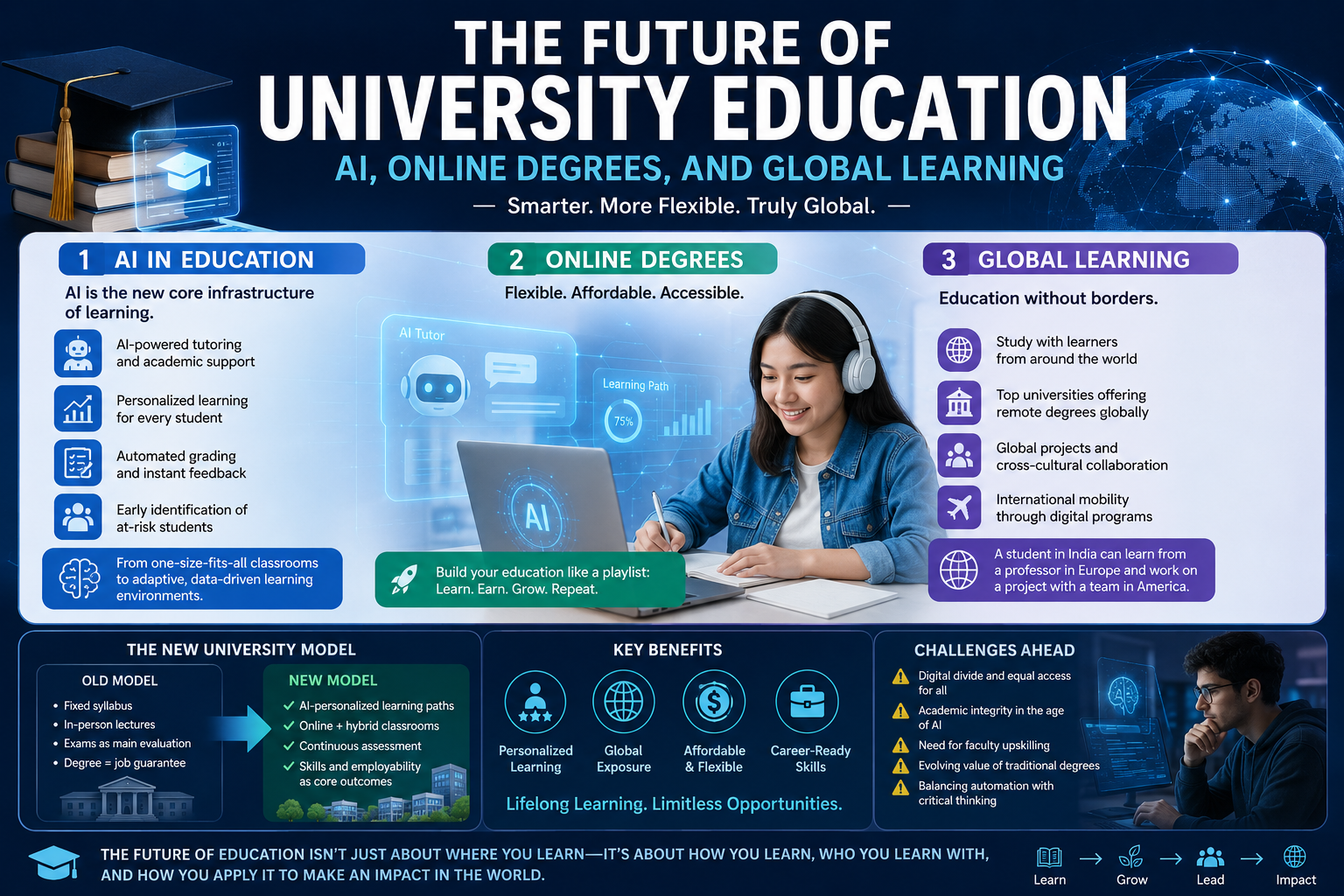
The future of university education is being reshaped by three powerful forces: Artificial Intelligence (AI), online degrees, and global digital learning ecosystems. Together, they are transforming how students learn, how universities operate, and what it means to earn a degree.
1. AI in University Education: From Tool to Core Infrastructure
AI is no longer an optional add-on in higher education—it is becoming the core operating system of learning.
Recent studies show that around 95% of students and educators now use AI tools in academic settings, from writing assistance to personalized tutoring and assessment support . Universities are increasingly using AI for:
- Personalized learning paths (adapting content to each student’s pace)
- Automated grading and feedback systems
- AI-powered tutoring and academic support
- Early detection of at-risk students (dropout prevention)
At the same time, institutions are struggling with governance—only about a quarter of universities have formal AI policies, even as adoption becomes nearly universal .
What this means
AI is shifting universities from “one-size-fits-all classrooms” to adaptive, data-driven learning environments.
2. Online Degrees: The Rise of Flexible, Stackable Education
Online education has moved from a backup option to a mainstream pathway for degrees and careers.
Universities and platforms now offer:
- Fully online bachelor’s and master’s degrees
- Micro-credentials and certificate stacking
- Hybrid programs (online + in-person combinations)
This shift is driven by:
- Rising tuition costs and student debt
- Demand for flexible learning for working professionals
- Employer preference for skills-based hiring
In practice, many learners now build education like a “playlist”:
short courses → certificates → degree completion → continuous upskilling
Online degrees are also becoming more credible as major institutions and global platforms expand their offerings and recognition systems.
3. Global Learning: Education Without Borders
Higher education is becoming increasingly borderless and international.
Key trends include:
- Millions of students studying across countries through digital programs
- Global classrooms with mixed-nationality cohorts
- International universities offering remote degrees worldwide
- Cross-border collaboration between institutions and industries
UNESCO reports that international student mobility has more than tripled in recent decades, reaching nearly 7 million learners globally .
What this changes
A student in India can now:
- Earn a degree from a US or European university online
- Collaborate in global project teams
- Access the same learning tools as students anywhere in the world
Education is becoming a global digital network rather than a physical campus experience.
4. The New University Model: Hybrid, AI-Driven, and Skills-Based
The traditional university model is evolving into a hybrid system:
Old model:
- Fixed syllabus
- In-person lectures
- Exams as main evaluation
- Degree = job guarantee
New model:
- AI-personalized learning paths
- Online + hybrid classrooms
- Continuous assessment (projects, portfolios, simulations)
- Skills and employability as core outcomes
Universities are now under pressure to prove real-world value and job readiness, especially in an AI-driven job market .
5. Key Challenges Ahead
Despite the progress, several challenges remain:
- Digital divide (unequal access to technology)
- Academic integrity issues with AI-generated work
- Need for faculty retraining in AI tools
- Questions about the long-term value of traditional degrees
- Over-reliance on automation without critical thinking development
Conclusion
The future of university education is not about replacing campuses—it’s about reinventing them.
We are moving toward a system where:
- AI personalizes learning for every student
- Online degrees make education globally accessible
- Universities act as lifelong learning hubs
- Skills matter as much as credentials
In short, higher education is shifting from a place you go to a system you continuously interact with throughout life.