
Introduction
Artificial Intelligence (AI) is rapidly transforming education systems worldwide. From automated grading tools to personalized tutoring platforms, AI is already playing a major role in how students learn. This has raised a provocative question: can AI fully replace human lecturers in universities?
Some experimental systems and “AI teaching assistants” can already deliver lectures, answer questions, and even design course materials. In some cases, AI-generated lectures have been produced in hours instead of weeks, showing impressive efficiency. However, universities are still fundamentally human-centered institutions. The debate is no longer just about technology—it is about the future purpose of education itself.
1. The Rise of AI in Higher Education
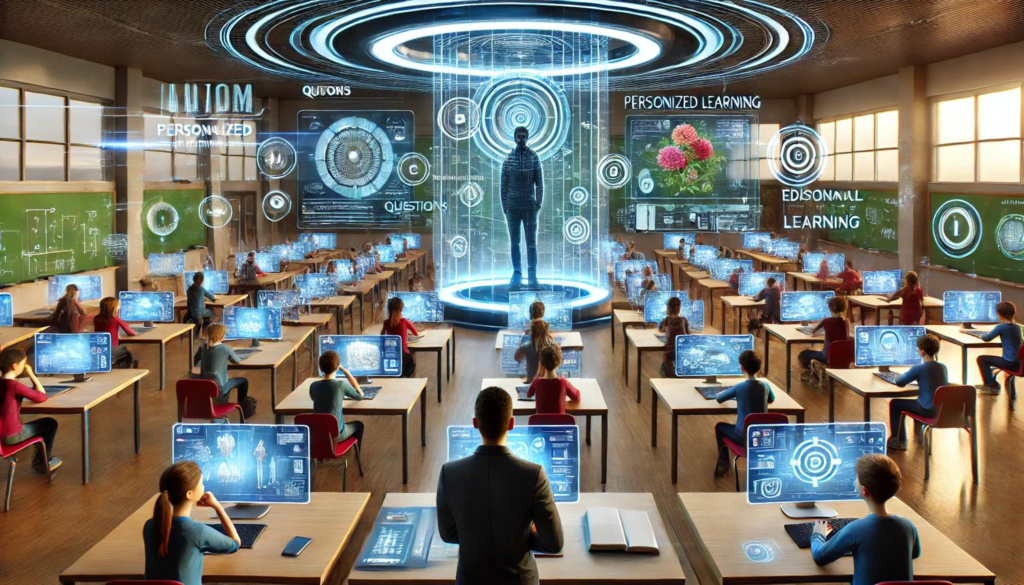
AI is becoming deeply embedded in university ecosystems. It is used for:
- Automated grading and feedback
- Personalized learning paths for students
- Chatbots that answer academic questions
- Course content generation and summarization
- Virtual simulations for practical training
Recent studies show that generative AI is already reshaping how lecturers prepare and deliver content, often reducing workload and improving efficiency .
In some universities, AI tools are even used to replicate entire lecture modules or assist in curriculum design. A notable experiment showed that AI systems could generate a full week-long master’s course structure in just hours, demonstrating how quickly educational content can be produced using AI systems .
However, this efficiency raises a deeper question: is faster content creation the same as better education?
2. What AI Can Do Better Than Human Lecturers
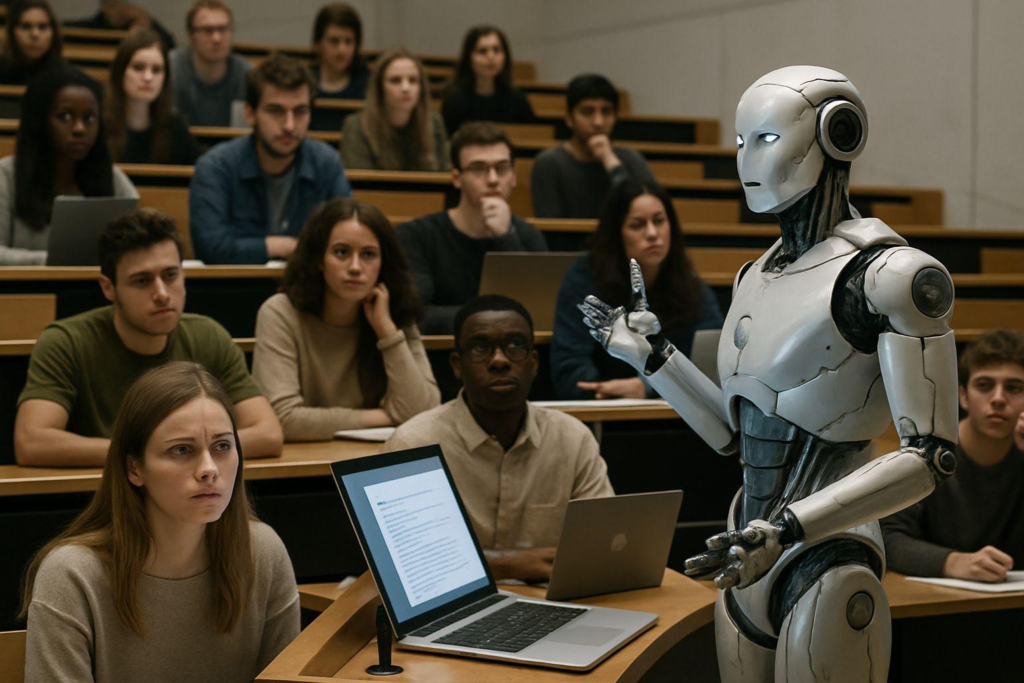
AI has clear advantages in certain academic tasks:
1. Instant knowledge delivery
AI can explain complex topics instantly, 24/7, without fatigue or inconsistency.
2. Personalization at scale
Unlike human lecturers, AI can adapt explanations to each student’s learning speed, style, and weaknesses.
3. Data-driven feedback
AI can analyze student performance patterns and provide precise suggestions for improvement.
4. Efficiency in administrative work
Grading, attendance tracking, and quiz generation can be automated, freeing lecturers from repetitive tasks.
5. Content scalability
A single AI system can teach millions of students simultaneously, making education globally accessible.
These strengths make AI a powerful educational assistant, but not necessarily a replacement for human educators.
3. What AI Cannot Replace in Human Teaching

Despite its strengths, AI has fundamental limitations in higher education.
Emotional intelligence and mentorship
University education is not only about information—it is about guidance, motivation, and personal development. Human lecturers mentor students through uncertainty, failure, and academic pressure in ways AI cannot authentically replicate.
Critical thinking and intellectual challenge
Good lecturers do not just provide answers; they challenge students to think deeper. AI tends to generate optimized answers but cannot truly “push back” with lived intellectual experience or moral reasoning.
Ethical and contextual understanding
Education often involves sensitive topics, cultural nuance, and ethical debates. AI lacks true moral judgment and lived experience.
Human connection
The relationship between lecturer and student often shapes career paths, confidence, and identity formation. This social dimension is still uniquely human.
Research consistently highlights that higher education depends on emotional, ethical, and social dimensions that AI cannot fully replicate .
4. The Reality: AI Will Transform, Not Replace Lecturers

The strongest consensus among educators is not replacement—but collaboration.
AI is likely to transform lecturers into:
- Learning designers rather than content deliverers
- Mentors rather than information providers
- Facilitators of discussion rather than sole knowledge sources
- Supervisors of AI-assisted learning environments
A growing view in academia suggests that the future professor is not someone replaced by AI, but someone who uses AI as a co-teacher .
In fact, universities are already redesigning courses where AI handles routine explanations while lecturers focus on higher-order thinking and research-based discussion.
5. Challenges and Risks of AI Professors
Despite its promise, replacing lecturers with AI introduces serious risks.
1. Loss of academic integrity
Students may become overly dependent on AI-generated answers, weakening critical thinking skills.
2. Reduced deep learning
Over-automation can turn education into passive consumption rather than active inquiry.
3. Unequal access
Not all students have equal access to advanced AI tools, potentially widening the education gap.
4. Institutional trust issues
Many students and faculty already express concern about AI replacing meaningful human teaching experiences .
5. Commercialization of education
If AI systems dominate teaching, universities risk becoming content providers rather than intellectual communities.
6. A Glimpse Into the Future University
The future university will likely look very different:
AI handles:
- Basic lectures
- Practice questions
- Grading
- Revision support
Human lecturers focus on:
- Mentorship and career guidance
- Research supervision
- Critical debates and seminars
- Ethical and philosophical discussions
This hybrid model suggests a “human + AI university” rather than an AI-only institution.
Some researchers even propose new institutional frameworks where AI is fully integrated into curriculum design, but still under human academic control and evaluation .
Conclusion
AI is not going to fully replace university lecturers—but it is already forcing them to evolve. The role of educators is shifting from knowledge transmitters to learning architects and mentors.
While AI can replicate lectures, summarize knowledge, and personalize learning at scale, it cannot replace human intuition, emotional intelligence, or mentorship. Universities are not just places for information—they are environments for intellectual growth, identity formation, and critical thinking.
The future of higher education is therefore not “AI professors vs human lecturers,” but AI-powered education guided by human wisdom.