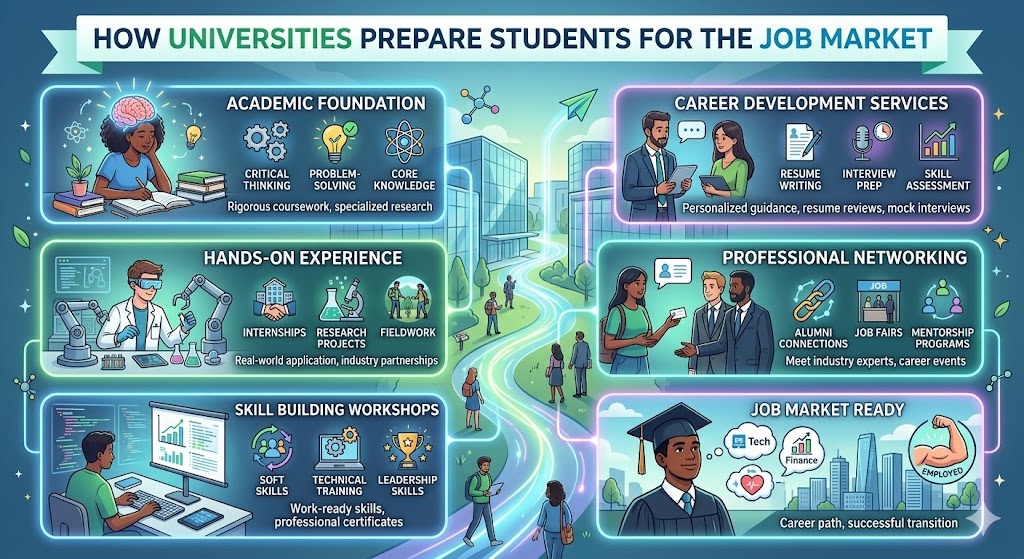
Universities play a crucial role in shaping students for the job market by combining academic learning with practical skills, industry exposure, and personal development. In today’s competitive world, a degree alone is not enough—employers look for graduates who are skilled, adaptable, and career-ready.
1. Academic Knowledge and Core Skills
Universities provide the foundational knowledge required in a chosen field. Whether it’s engineering, business, medicine, or arts, structured coursework helps students build strong theoretical understanding. Along with subject knowledge, students also develop core skills like critical thinking, problem-solving, research ability, and communication.
These skills form the base for any professional career and are essential for performing effectively in real-world jobs.
2. Practical Training and Hands-on Experience
Most universities now include practical learning through labs, workshops, case studies, and simulations. These experiences help students apply what they learn in classrooms to real-life situations.
Internships, industrial training, and fieldwork are also key parts of many degree programs. They allow students to gain workplace exposure, understand job roles, and build confidence before entering the professional world.
3. Internships and Industry Connections
Internships act as a bridge between education and employment. Universities often collaborate with companies to provide internship opportunities where students can work on real projects.
These experiences not only improve technical and professional skills but also help students build networks with industry professionals. In many cases, internships lead directly to full-time job offers.
4. Career Services and Skill Development Programs
Modern universities offer dedicated career support services. These include resume-building workshops, interview preparation sessions, personality development classes, and career counseling.
Many institutions also conduct job fairs and campus recruitment drives where companies directly hire graduating students. This makes it easier for students to transition into the workforce smoothly.
5. Soft Skills and Personality Development
Success in the job market is not just about technical knowledge. Universities help students develop soft skills such as teamwork, leadership, adaptability, time management, and emotional intelligence.
Participation in group projects, presentations, clubs, and extracurricular activities plays a major role in building these skills.
Conclusion
Universities prepare students for the job market by combining academic learning with practical exposure, professional training, and personal development. By the time students graduate, they are expected not only to understand their field but also to apply their knowledge effectively in real-world situations. This holistic preparation helps bridge the gap between education and employment, making graduates more competitive and job-ready.