India’s technical education sector is entering another important phase of institutional development. The All India Council for Technical Education (AICTE) has launched four schemes for the 2026–27 academic year, aiming to strengthen college infrastructure, encourage practical learning, promote academic collaboration and improve institutional capabilities.
Announced on October 31, 2026, the initiatives are IDEA Lab, Modernisation and Removal of Obsolescence (MODROBS), Margdarshan, and Grant for Organising Conference (GOC). They are part of AICTE’s institutional development efforts and are intended to widen opportunities for technical institutions across the country, including colleges beyond established education hubs. Education News – The Indian Express+2
The announcement is significant because the quality of technical education depends on more than classroom teaching. Students also need access to functional laboratories, opportunities to experiment, exposure to current research and guidance from experienced academic institutions. The four schemes address these needs from different angles.
Understanding the Four AICTE Schemes for 2026–27
The four initiatives have different objectives, but they share one broad ambition: to help technical institutions create stronger learning environments. Rather than focusing on a single aspect of education, the package covers practical innovation, equipment modernisation, institutional mentoring and academic knowledge exchange.
| Scheme | Main focus |
|---|---|
| IDEA Lab | Hands-on learning, experimentation and prototype development |
| MODROBS | Modernising laboratories, workshops and computing facilities |
| Margdarshan | Academic mentoring and institutional improvement |
| GOC | Support for national and international academic conferences |
AICTE Chairman Professor Yogesh Singh launched the schemes in the presence of Member Secretary Professor Shyama Rath. At the launch, Singh highlighted the importance of research-oriented and innovation-driven learning, and encouraged institutions to use emerging technologies, including artificial intelligence, to make teaching more interactive and student-centred. The New Indian Express+1
IDEA Lab: Turning Classroom Knowledge into Practical Innovation 💡
One of the most student-focused initiatives in the package is the IDEA Lab scheme. The name refers to Idea Development, Evaluation and Application. Its central purpose is to encourage students to move beyond learning technical concepts from textbooks and apply those concepts to practical challenges.
Engineering and technology education involves a combination of theory, experimentation and problem-solving. A student may understand the principles of electronics, mechanical design, programming or material science during lectures, but developing a working solution requires a different set of experiences. Students must test assumptions, identify errors, revise designs and learn from results.
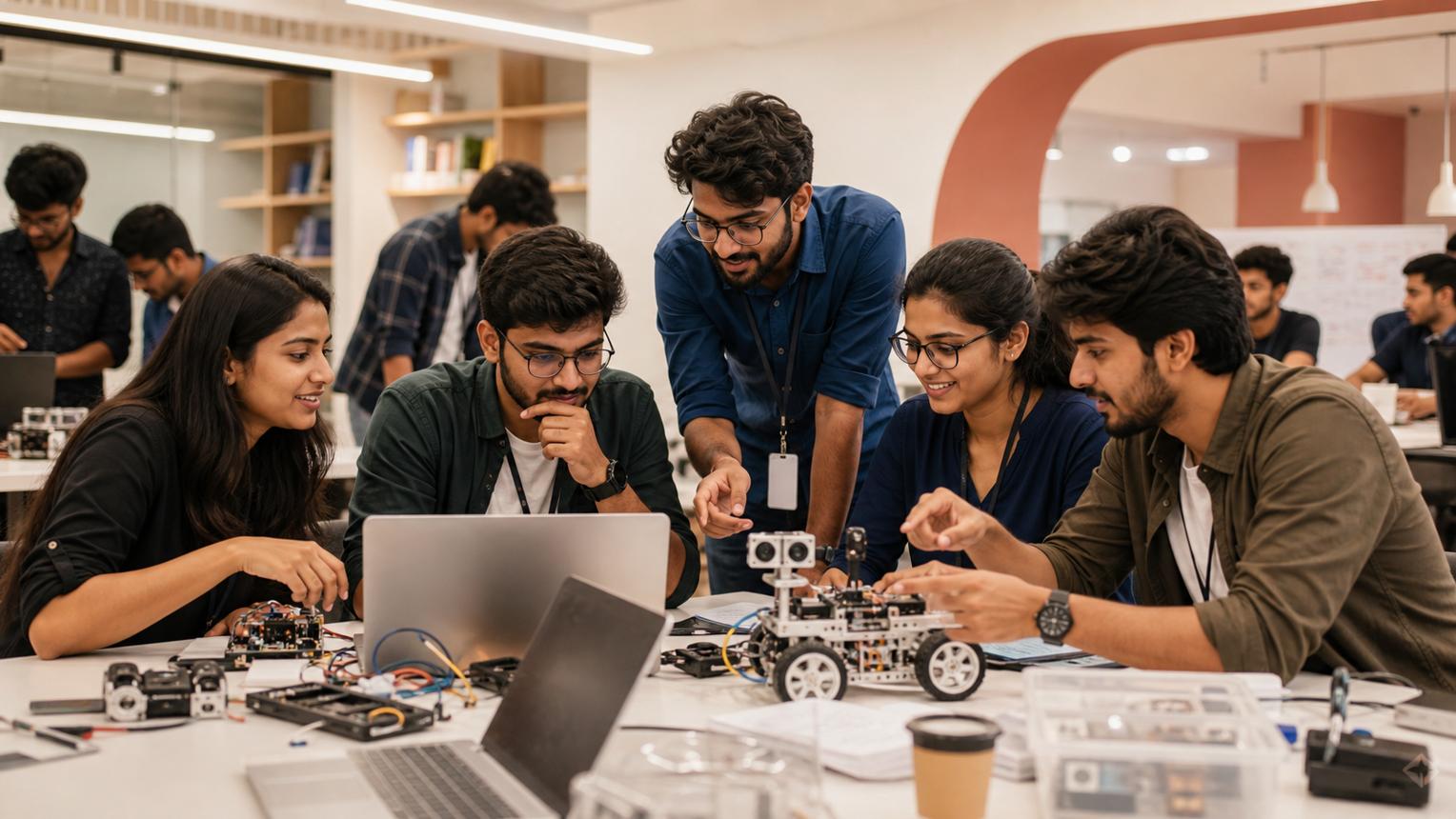
The IDEA Lab approach supports this process through the principle of learning by doing. It is intended to provide a dedicated environment where students can explore science, technology, engineering and mathematics (STEM) concepts through experiments, prototyping and product visualisation. Elets Digital Learning+1
For example, a group of engineering students interested in renewable energy might develop a small solar-powered device. Another team could experiment with a low-cost water-quality monitoring system, while computer science students might create a prototype for a campus accessibility application. These are illustrative examples of the kinds of projects that hands-on innovation spaces can encourage, rather than a list of projects guaranteed under the scheme.
The educational value lies not only in the final product but also in the process. Students learn to divide responsibilities, research possible solutions, work with tools, document their findings and present their ideas. They also become familiar with the fact that early prototypes rarely work perfectly.
Why IDEA Lab matters for students
An innovation laboratory can help students develop capabilities that are difficult to acquire through lectures alone. These include:
- Practical problem-solving: Applying classroom concepts to real situations.
- Creative thinking: Exploring different ways to approach a technical challenge.
- Teamwork: Working with students from different academic backgrounds.
- Technical confidence: Becoming comfortable with tools, equipment and experimentation.
- Communication: Explaining a design, demonstrating a prototype and responding to feedback.
- Entrepreneurial thinking: Recognising how an idea could eventually become a useful product or service.
An IDEA Lab can also support interdisciplinary learning. Many modern problems do not belong to one branch of engineering. A smart agriculture project, for instance, could involve sensors, data analysis, mechanical design, software and environmental knowledge. A shared innovation space gives students an opportunity to combine these skills.
For colleges, the challenge will be to make such facilities accessible and active throughout the academic year. A laboratory should not become a room that students visit only during scheduled demonstrations. Its value depends on regular project work, faculty guidance, equipment availability and a culture that welcomes experimentation.
MODROBS: Modernising Laboratories for Contemporary Technical Education 🧪
The second major initiative, MODROBS, addresses a practical issue faced by many technical institutions: outdated laboratory equipment and infrastructure.
MODROBS stands for Modernisation and Removal of Obsolescence in AICTE’s scheme terminology. Some launch-day reports use a different expansion, but the established scheme name is Modernisation and Removal of Obsolescence. Its purpose is to help institutions upgrade facilities such as laboratories, workshops and computing infrastructure so that students and faculty can work with more relevant equipment. Elets Digital Learning+1
Laboratories are essential to technical education. They allow students to observe how theories work in practice, conduct measurements, test materials, operate instruments and understand the limitations of engineering systems. When equipment becomes outdated or unreliable, the quality of practical learning can suffer.
Consider a student studying computer engineering. Modern courses increasingly involve data-intensive applications, simulation, artificial intelligence and advanced software tools. If the institution’s computing facilities cannot support these activities, students may have fewer opportunities to practise the skills expected in contemporary workplaces.
The same concern applies to other disciplines. Mechanical engineering students need access to relevant workshop equipment. Electrical engineering students require suitable testing and measurement facilities. Civil engineering students benefit from updated material-testing instruments, while electronics students need functioning equipment for circuit design and analysis.
MODROBS is designed to support the modernisation of these institutional facilities. Elets Digital Learning’s report on the scheme states that AICTE guidelines provide support of up to ₹20 lakh per project over two years, with a dedicated window for institutions in rural areas, the North Eastern Region and Jammu and Kashmir. Institutions should verify the applicable current guidelines before planning a proposal, as funding conditions and eligibility can differ by scheme and application cycle. Elets Digital Learning
How laboratory modernisation can improve learning
Updated equipment can make practical sessions more meaningful. Students may be able to work with better instruments, perform more accurate experiments and explore topics that were previously difficult to teach using available facilities.
Modernisation can also benefit faculty members. Teachers and laboratory staff can demonstrate current methods, design more relevant practical assignments and support research activities. In some cases, upgraded facilities may help departments build stronger links with industry by exposing students to tools and processes used in professional environments.
However, purchasing equipment is only one part of successful modernisation. Institutions must also consider maintenance, calibration, technical support, safety procedures and faculty training. A new machine that remains unused because nobody has been trained to operate it will not improve educational outcomes.
A good modernisation plan should therefore begin with an assessment of existing facilities. Colleges need to identify which equipment is obsolete, which laboratories are heavily used, what skills students need and which upgrades would produce the greatest academic benefit.
Margdarshan: Building Stronger Colleges Through Academic Mentoring 🤝
The Margdarshan scheme focuses on a different challenge: improving institutional quality through guidance, collaboration and the sharing of experience.
Not every technical institution has the same academic resources. Some colleges have established research centres, experienced faculty teams, mature quality-assurance systems and strong industry networks. Others may be working to improve curriculum delivery, research activity, accreditation readiness and institutional management.
Margdarshan is intended to connect institutions with established academic organisations that can provide mentoring and support. According to Elets Digital Learning, the model can involve a well-established AICTE-approved institution acting as a hub to guide up to ten nearby institutions. The programme also allows senior academicians to serve as individual mentors, known as Margdarshaks. Elets Digital Learning
The goal is not simply to offer occasional advice. Effective mentoring can help colleges review their academic practices, identify gaps and develop a structured plan for improvement.
For example, a college seeking to strengthen its accreditation preparation may need to improve documentation, teaching-learning processes, faculty development, student support and outcome measurement. An experienced mentor institution can share practical methods and help the college understand how to organise these activities more effectively.
Margdarshan is also associated with efforts to improve institutional performance, including progress towards National Board of Accreditation (NBA) accreditation and stronger National Institutional Ranking Framework (NIRF) performance. Elets Digital Learning+1
Why mentoring is important for technical institutions
Institutional improvement can be difficult when colleges work in isolation. A mentoring relationship gives institutions an opportunity to learn from the experiences of others rather than developing every process independently.
Potential areas of support include:
- Curriculum planning and outcome-based education.
- Faculty development and academic leadership.
- Quality assurance and accreditation preparation.
- Research planning and project development.
- Student mentoring and academic support.
- Resource sharing and institutional collaboration.
- Better systems for monitoring academic performance.
The success of Margdarshan will depend on the quality of these relationships. Mentoring should be continuous, practical and adapted to the needs of each participating institution. A single workshop or a generic presentation is unlikely to produce lasting change.
Institutions receiving guidance must also take ownership of their improvement plans. Mentors can share knowledge and provide direction, but the beneficiary college needs to implement recommendations, evaluate progress and maintain improvements over time.
GOC: Encouraging Research and Academic Exchange 🌍
The fourth initiative is the Grant for Organising Conference (GOC). It supports institutions that organise national and international academic conferences, creating opportunities for faculty members, researchers, students and subject experts to exchange knowledge.
Academic conferences play an important role in the development of higher education. They bring together people working on related subjects, allow researchers to present their findings and create opportunities to discuss new developments. They can also help students understand how research communities operate beyond their own campuses.
A conference may focus on artificial intelligence, sustainable energy, biotechnology, advanced manufacturing, cybersecurity, civil infrastructure or another specialised field. Participants can listen to expert presentations, discuss research methods, explore emerging questions and establish professional connections.
AICTE’s GOC scheme is intended to facilitate this kind of academic interaction through support for institutions organising national and international conferences. Elets Digital Learning+1
How conferences benefit students and researchers
For students, attending a conference can be an introduction to research beyond the curriculum. They may discover areas of study they had not previously considered, learn how experts approach difficult problems and gain confidence in presenting their own work.
For research scholars and faculty members, conferences can provide a platform to share findings, receive feedback and identify potential collaborators. A researcher working on a new material, for example, may meet another academic with complementary expertise. Their discussion could lead to a joint project or a new research direction.
Conferences can also strengthen the academic culture of an institution. When colleges regularly host serious discussions and research presentations, they create more opportunities for students and faculty to engage with current developments.
However, the quality of a conference matters more than the size of its audience. A successful event should have a clear academic theme, relevant speakers, meaningful discussions and opportunities for participants to learn. Institutions should focus on genuine knowledge exchange rather than treating conferences only as ceremonial events.
How the Four Schemes Work Together
Although IDEA Lab, MODROBS, Margdarshan and GOC address different needs, their combined value may be greater than the impact of any one initiative in isolation.
IDEA Lab encourages students to develop ideas and test solutions. MODROBS can help ensure that laboratories, workshops and computing facilities are suitable for practical learning and research. Margdarshan can support institutions as they improve academic processes and institutional quality. GOC can connect faculty members and students with wider research communities.
Consider a hypothetical engineering college that wants to develop a stronger robotics programme. An IDEA Lab could provide a setting for student teams to design and test prototypes. Modernised laboratory equipment supported through MODROBS could improve their ability to conduct experiments. Mentoring through Margdarshan could help the institution strengthen its curriculum, faculty practices and quality systems. A conference supported through GOC could bring researchers and industry experts together to discuss robotics, automation and related technologies.
This example illustrates how the four areas can complement one another. It does not mean that every institution will automatically receive support under all four schemes or that approval for one scheme guarantees access to another.
Robotics Product Development Internship | Raspberry Pi, AI Vision & Robot App
The broader idea is to create a connected academic environment. Infrastructure, teaching quality, research and collaboration should reinforce one another. A well-equipped laboratory is more useful when students have meaningful projects. Research becomes stronger when faculty members can access suitable facilities and collaborate with peers. Institutional mentoring is more effective when colleges have the resources and leadership to implement improvements.
Why the AICTE Announcement Matters for India’s Technical Education System
India has a large and diverse technical education ecosystem. Institutions differ in their locations, facilities, student populations, faculty strength, research experience and access to industry. A scheme that works well for a major metropolitan engineering college may need a different implementation approach in a smaller institution.
The 2026–27 initiatives are important because they recognise several dimensions of institutional development. They do not treat educational quality as a matter of infrastructure alone. Instead, they bring together student innovation, modern facilities, academic mentoring and research exchange.
Reducing the Gap Between Theory and Practice
One continuing challenge in technical education is ensuring that students can apply what they learn. Theoretical knowledge is essential, but engineering and technology careers also demand the ability to solve practical problems.
Students need opportunities to build, test, measure, debug and improve. IDEA Lab and MODROBS are particularly relevant to this objective. One promotes a culture of experimentation, while the other focuses on the facilities that make practical work possible.
The relationship between the two is important. A college may encourage innovation, but students need appropriate equipment to develop their ideas. Equally, modern equipment has limited value if students are not encouraged to use it creatively.
Supporting Colleges Outside Major Education Hubs
Access to academic resources can vary significantly by region. Institutions located in large cities may have greater access to research networks, industry partnerships and specialised facilities. Colleges in smaller towns or remote areas may face additional challenges.
AICTE has said the new initiatives are intended to encourage wider participation from institutions across districts, rather than limiting institutional development opportunities to established technical education centres. The MODROBS information reported by Elets also identifies a dedicated window for rural institutions, the North Eastern Region and Jammu and Kashmir. Education News – The Indian Express+1
A wider distribution of institutional support could help more students access practical learning and research opportunities closer to home. It may also encourage colleges to build regional academic networks.
Yet equitable access requires more than announcing a scheme. Institutions must be aware of the opportunities, understand the application process and have the administrative capacity to prepare proposals. Clear guidance and transparent selection procedures will be important.
Improving the Relevance of Technical Education
Technology changes quickly. Fields such as artificial intelligence, robotics, cybersecurity, semiconductor design, biotechnology and advanced manufacturing continue to evolve. Technical institutions need to review their teaching methods and facilities to keep pace.
AICTE Chairman Professor Yogesh Singh highlighted the need for institutions to rethink teaching approaches and make classrooms more interactive and student-centred. He also referred to the role of emerging AI tools in teaching and learning. The New Indian Express
The schemes could support this transition by giving institutions more opportunities to modernise facilities, promote student experimentation and strengthen academic connections. But technology adoption should be guided by educational needs. Buying the latest equipment or introducing an AI tool does not automatically improve learning. Institutions must connect new resources to clear learning outcomes.
Encouraging a Research-Oriented Campus Culture
Research is not limited to postgraduate laboratories or specialised universities. Undergraduate students can also learn research skills by investigating problems, conducting experiments and presenting findings.
IDEA Lab can help create an environment where students explore ideas, while GOC can expose them to wider academic conversations. MODROBS can strengthen the facilities required for experimentation, and Margdarshan can help institutions improve the systems that support research and academic quality.
Over time, these activities may encourage more students to consider research careers or advanced study. They may also help faculty members identify opportunities for interdisciplinary projects.
What Colleges Should Consider Before Applying
The announcement has created opportunities for eligible institutions, but colleges should avoid assuming that all details are identical across the four schemes. Funding limits, application windows, eligibility requirements, documentation and selection criteria are scheme-specific.
The initial launch coverage did not provide a complete set of institution-wise eligibility conditions or application deadlines. Institutions should therefore consult the relevant AICTE scheme guidelines and official application notices before preparing a proposal. Education News – The Indian Express+1
A careful preparation process can help institutions avoid common mistakes.
Review the official scheme guidelines. Colleges should identify the scheme that best matches their needs and check whether they meet its eligibility requirements.
Assess institutional priorities. A college with outdated laboratory equipment may prioritise MODROBS, while an institution seeking to create a stronger innovation culture may explore IDEA Lab. Institutions interested in mentoring or academic conferences should examine Margdarshan and GOC respectively.
Prepare a realistic project plan. Proposals should explain the problem, planned activities, expected outcomes, resources required and how the project will be maintained.
Check financial and administrative requirements. Institutions should carefully review permissible expenditure, supporting documents, reporting obligations and any conditions related to institutional contributions.
Plan for long-term use. Facilities and programmes should remain useful after the initial funding period. Colleges need to consider maintenance, staff responsibilities, student access and future operating costs.
Monitor official announcements. Application dates and procedural instructions should be taken from current AICTE notices rather than assumed from older scheme cycles or third-party summaries.
A proposal should demonstrate how the requested support will improve education, not merely describe a list of purchases or activities. Clear objectives and measurable outcomes can make institutional planning more effective.
What Students Can Expect from the New Initiatives
The four schemes are primarily designed to support institutions rather than provide direct scholarships to individual students. Nevertheless, students could benefit considerably if their colleges successfully participate and implement the programmes.
For students, the most visible change may be better access to practical learning. Instead of limiting projects to demonstrations or textbook exercises, colleges may be able to create more opportunities for students to develop prototypes, work with updated equipment and investigate real-world challenges.
More Opportunities for Project-Based Learning
Project-based learning encourages students to take responsibility for solving a problem. They must understand the requirements, research possible approaches, design a solution, test it and explain the outcome.
IDEA Lab could support this approach by encouraging experimentation and prototype development. Students from different departments may also get opportunities to work together on projects that combine multiple disciplines.
For example, a project to develop an automated waste-segregation system could involve mechanical engineering, electronics, programming and environmental studies. Such collaboration can help students understand how different technical fields contribute to a complete solution.
Better Preparation for Employment
Employers often look for more than academic marks. They may also value practical knowledge, communication, teamwork, adaptability and the ability to approach unfamiliar problems.
Students who regularly participate in laboratory work, research projects and technical discussions can develop experience that complements their classroom education.
MODROBS could help institutions improve the equipment available for practical training. IDEA Lab could encourage students to create and test solutions. GOC could provide exposure to experts and research developments. Margdarshan could indirectly improve the academic environment in which students learn.
These initiatives cannot guarantee employment or placements. Career outcomes depend on many factors, including individual performance, the quality of teaching, industry conditions and the opportunities available at each institution. However, stronger practical education can help students build a more relevant foundation for their future careers.
Greater Exposure to Research and Innovation
Students interested in postgraduate study or research careers may benefit from a campus environment that encourages experimentation and academic exchange.
Conferences can introduce them to research questions and emerging technologies. Innovation labs can provide opportunities to test ideas, while improved facilities can support more advanced practical work.
Students should take advantage of these opportunities by participating in projects, seeking faculty guidance, documenting their work and developing the confidence to present their findings.
The Role of Faculty Members and Institutional Leadership
The success of the AICTE schemes will depend heavily on teachers, laboratory staff, academic leaders and institutional administrators.
Faculty members play a central role in converting infrastructure into meaningful learning. A modern laboratory is useful only when educators design relevant experiments, explain technical concepts and guide students through practical challenges.
Teachers may also need professional development to work with new equipment, software and teaching methods. As artificial intelligence and other technologies become more common, faculty members will need to evaluate which tools genuinely support learning and how they can be used responsibly.
Institutional leadership must provide the planning and management required to sustain these initiatives. This includes assigning responsibilities, maintaining facilities, monitoring expenditure, supporting student participation and reviewing outcomes.
A successful project should not be measured only by the number of machines purchased, workshops conducted or conferences organised. It should also be evaluated through improvements in student learning, research activity, faculty capability and institutional performance.
Challenges That Could Affect Implementation
Although the schemes offer important opportunities, their implementation may face practical challenges.
Infrastructure gaps: Some institutions may require basic repairs or electrical upgrades before installing advanced equipment.
Faculty availability: Laboratories and innovation spaces need trained personnel who can guide students and maintain equipment.
Long-term maintenance: Institutions must plan for servicing, replacement parts, software updates and recurring operating expenses.
Unequal institutional capacity: Colleges with limited administrative resources may find it harder to prepare detailed applications and manage funded projects.
Student participation: Facilities need to be integrated into regular academic activities so that students from different backgrounds can benefit.
Measuring outcomes: Institutions should establish clear indicators to understand whether the schemes are improving teaching, research and student development.
These challenges do not reduce the importance of the initiatives. Instead, they highlight why planning, transparent administration and regular evaluation will be essential.
The Future of Technical Education in India: From Degrees to Demonstrable Skills 🚀
The future of technical education will increasingly depend on how effectively institutions connect academic knowledge with practical capabilities. Employers, research organisations and society need graduates who can understand complex problems, work with technology and develop responsible solutions.
The AICTE schemes for 2026–27 reflect this broader direction. IDEA Lab promotes experimentation and innovation. MODROBS focuses on modernising institutional facilities. Margdarshan encourages academic mentoring and quality improvement. GOC supports knowledge exchange through conferences.
Together, these initiatives provide a framework for addressing several important requirements of technical education.
Their long-term impact will depend on how institutions translate the opportunities into meaningful activities. An IDEA Lab must become an active space for student creativity. Modernised laboratories must be integrated into teaching and research. Mentoring must lead to measurable institutional improvement. Conferences must create genuine opportunities for academic discussion.
The wider ambition should be to build colleges where students are encouraged to ask questions, test ideas, learn from mistakes and collaborate with others. Such an environment can help technical education become more responsive to changing technologies and real-world needs.
For students, the message is equally important: a degree is a foundation, but practical experience, curiosity and continuous learning are essential parts of professional growth.
Conclusion
AICTE’s four major schemes for the 2026–27 academic year represent an important effort to strengthen India’s technical education ecosystem. By supporting innovation laboratories, modernising institutional infrastructure, encouraging academic mentoring and facilitating conferences, the initiatives address different but connected dimensions of educational quality.
IDEA Lab can help students transform concepts into prototypes. MODROBS can improve the facilities needed for practical learning and research. Margdarshan can help institutions benefit from the experience of established academic organisations. GOC can create platforms for researchers, teachers and students to exchange knowledge.
The announcement is a positive development, particularly for institutions seeking to improve their academic capabilities and expand opportunities for students. However, the real measure of success will be implementation: whether colleges can use the support effectively, maintain the facilities and demonstrate improvements in teaching, research and student learning.
If these objectives are achieved, the four schemes could contribute to a more innovative, collaborative and practical technical education environment across India. 🎓🇮🇳