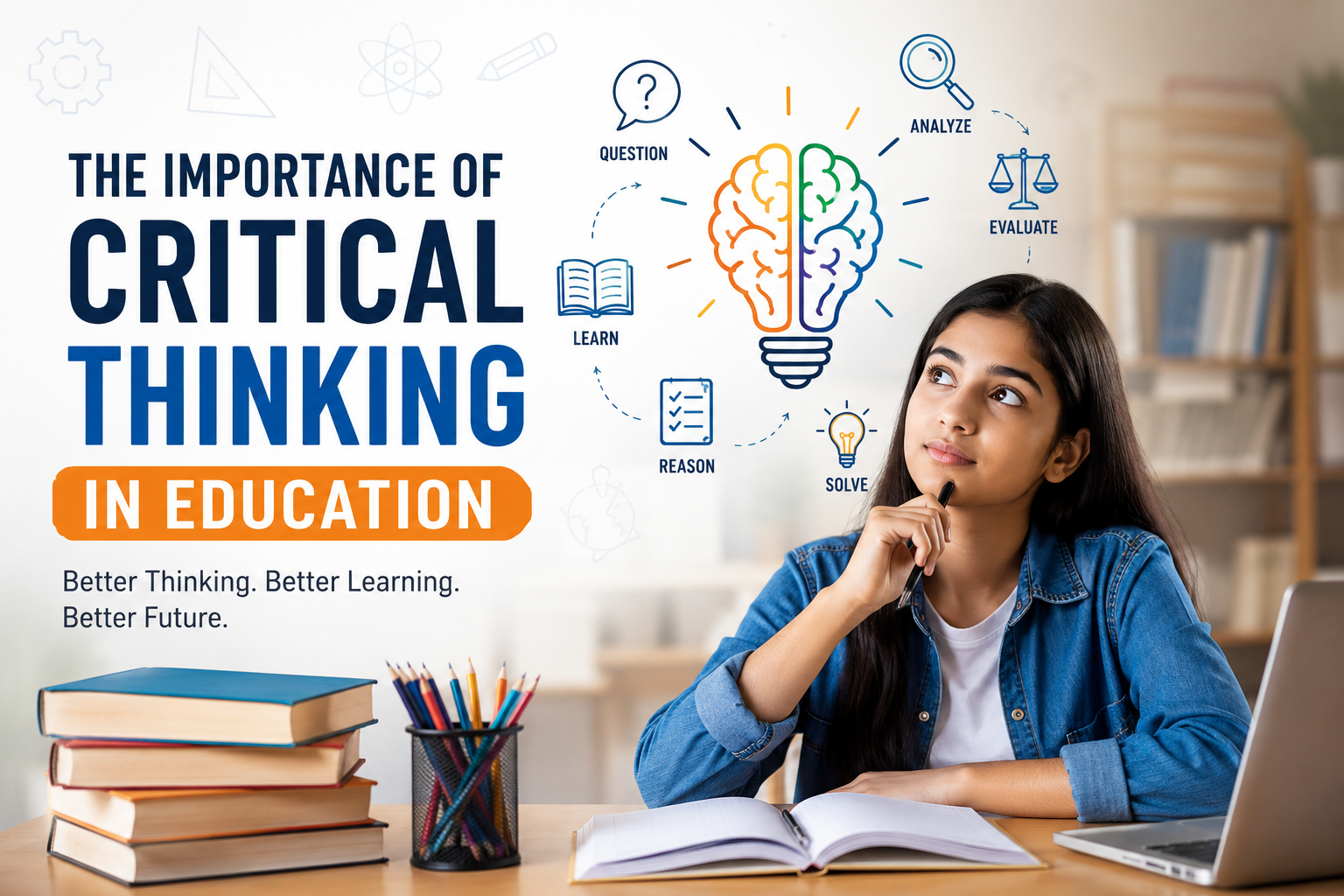
In today’s rapidly changing world, education is no longer just about memorizing facts or passing exams. Students need skills that help them analyze information, solve complex problems, and make informed decisions. One of the most valuable skills developed through education is critical thinking.
Critical thinking enables learners to evaluate evidence, question assumptions, and think independently. As technology, artificial intelligence, and digital media continue to transform society, the ability to think critically has become essential for academic success, career growth, and responsible citizenship.
What Is Critical Thinking?
Critical thinking is the ability to analyze information objectively, evaluate different perspectives, and make reasoned judgments based on evidence rather than emotions or assumptions.
A critical thinker can:
- 🔍 Analyze facts carefully
- 🤔 Ask meaningful questions
- 📚 Evaluate sources of information
- 💡 Generate creative solutions
- ⚖️ Make logical decisions
- 🧩 Solve complex problems
Instead of simply accepting information as true, critical thinkers examine the evidence before forming conclusions.
Why Critical Thinking Is Important in Education
1. Improves Problem-Solving Skills 🧩
Education constantly presents students with challenges—from mathematics and science to social issues and real-life situations. Critical thinking helps students break problems into smaller parts, analyze possible solutions, and choose the best approach.
Students who think critically become better at handling unfamiliar situations confidently.
2. Encourages Independent Learning 📖
Rather than depending entirely on teachers or textbooks, critical thinkers take responsibility for their own learning.
They:
- Research independently
- Verify information
- Explore multiple viewpoints
- Develop curiosity
This habit creates lifelong learners who continue improving even after formal education ends.
3. Enhances Academic Performance 🎓
Students who apply critical thinking understand concepts more deeply instead of memorizing them.
Benefits include:
- Better comprehension
- Stronger analytical writing
- Improved classroom discussions
- Higher-quality research
- Better exam performance
Understanding “why” something works is more valuable than simply remembering the answer.
4. Develops Better Decision-Making Skills ⚖️
Every day, students make decisions about studies, friendships, careers, finances, and personal goals.
Critical thinking helps them:
- Compare options
- Consider consequences
- Evaluate risks
- Make informed choices
These decision-making skills remain valuable throughout life.
5. Encourages Creativity and Innovation 💡
Critical thinking and creativity work together.
When students question existing ideas and explore different perspectives, they often discover innovative solutions.
Many successful entrepreneurs, scientists, engineers, and inventors rely on critical thinking to create groundbreaking ideas.
6. Helps Identify Misinformation 🌐
The internet provides unlimited information—but not all of it is accurate.
Critical thinking enables students to:
- Verify facts
- Check reliable sources
- Detect fake news
- Recognize misinformation
- Avoid manipulation
These digital literacy skills are essential in today’s information age.
7. Strengthens Communication Skills 🗣️
Critical thinkers express ideas clearly because they organize their thoughts logically.
They can:
- Present evidence
- Build strong arguments
- Respect opposing opinions
- Participate in meaningful discussions
Effective communication is highly valued in both education and the workplace.
8. Builds Confidence 💪
Students become more confident when they trust their ability to analyze situations and make sound decisions.
Instead of relying solely on others, they develop confidence in their reasoning abilities.
Benefits of Critical Thinking for Teachers
Critical thinking is equally valuable for educators.
Teachers who encourage critical thinking:
- Create engaging classrooms
- Promote active participation
- Inspire curiosity
- Improve student motivation
- Encourage collaboration
- Prepare students for real-world challenges
Learning becomes interactive rather than based only on lectures.
Critical Thinking in Different Subjects
Mathematics
Students learn to:
- Analyze problems
- Compare multiple solution methods
- Understand logical reasoning
Science
Students:
- Conduct experiments
- Evaluate evidence
- Form hypotheses
- Draw conclusions
Literature
Students analyze:
- Themes
- Characters
- Symbolism
- Author’s perspective
History
Critical thinking helps students:
- Examine historical evidence
- Compare viewpoints
- Understand causes and effects
- Avoid biased interpretations
Social Studies
Students learn to:
- Discuss social issues
- Evaluate public policies
- Understand global challenges
- Develop informed opinions
Strategies to Develop Critical Thinking in Students
Ask Open-Ended Questions
Instead of asking questions with one correct answer, encourage students to explain their reasoning.
Example:
❌ What is the capital of India?
✅ Why is New Delhi important for India’s administration and economy?
Encourage Classroom Discussions
Healthy debates expose students to different viewpoints and improve reasoning skills.
Use Real-Life Problems
Practical examples help students connect classroom knowledge with everyday life.
Promote Research
Students should learn how to:
- Compare multiple sources
- Evaluate evidence
- Cite reliable information
- Draw independent conclusions
Encourage Reflection
Reflection allows students to evaluate what they learned, what worked, and what can be improved.
Teach Media Literacy
Students should learn how to identify:
- Fake news
- Clickbait
- Biased reporting
- Misleading statistics
- AI-generated misinformation
The Role of Technology in Critical Thinking
Technology can both support and challenge critical thinking.
Positive uses include:
- Interactive learning platforms
- Educational videos
- Virtual laboratories
- AI-powered tutoring
- Online research databases
However, students must also learn to evaluate digital content critically rather than accepting everything they read online.
Challenges in Developing Critical Thinking
Some common obstacles include:
- Memorization-focused education
- Fear of making mistakes
- Limited classroom discussions
- Information overload
- Poor digital literacy
- Lack of questioning habits
Schools can overcome these challenges by encouraging curiosity, collaboration, and inquiry-based learning.
Critical Thinking and Future Careers
Employers consistently value professionals who can:
- Solve problems
- Analyze data
- Make informed decisions
- Adapt to change
- Communicate effectively
- Work collaboratively
Whether pursuing careers in engineering, medicine, law, business, education, or technology, critical thinking remains one of the most important professional skills.
Tips for Students to Improve Critical Thinking
- 📚 Read widely from reliable sources.
- ❓ Ask “why” and “how” regularly.
- 🧩 Solve puzzles and logic problems.
- 📝 Reflect on your learning.
- 💬 Participate in discussions.
- 🔍 Verify information before sharing it.
- 🌍 Consider multiple perspectives.
- 📖 Practice evidence-based reasoning.
Conclusion
Critical thinking is one of the most essential skills that education can provide. It empowers students to analyze information, solve problems, communicate effectively, and make informed decisions throughout their lives. In an era of rapid technological change and overwhelming access to information, the ability to think independently is more valuable than ever.
By fostering curiosity, encouraging thoughtful discussion, and emphasizing evidence-based reasoning, educators can prepare students not only for academic achievement but also for successful careers and responsible participation in society. Investing in critical thinking today helps build confident, adaptable, and innovative individuals who are ready to face the challenges of tomorrow.