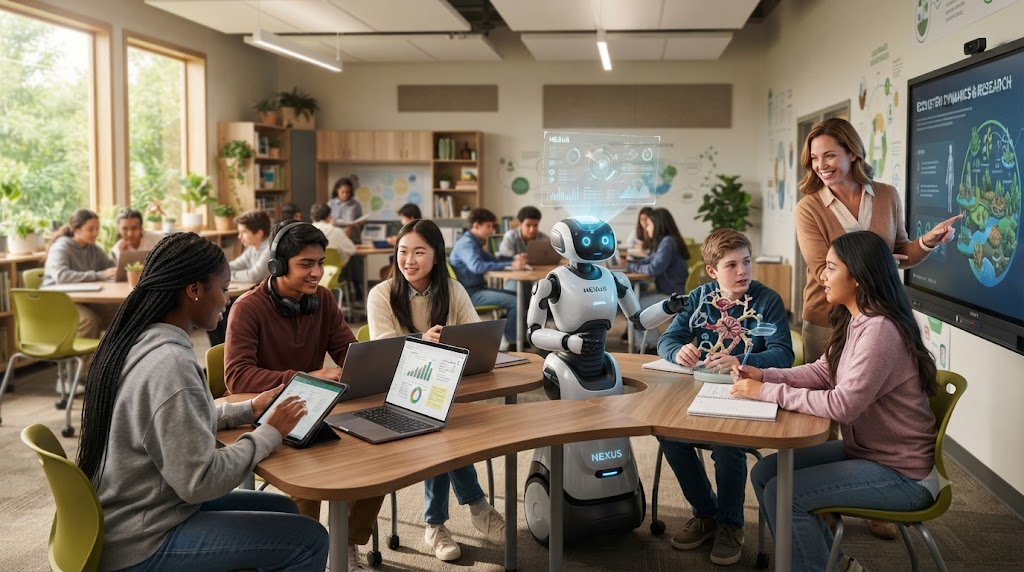
🌍 Introduction: Education Enters the Age of Artificial Intelligence
Artificial intelligence is rapidly becoming part of everyday life, and education is one of the fields experiencing some of the most interesting changes. From AI-powered tutoring systems and personalized learning platforms to automated feedback, intelligent educational assistants, and adaptive assessments, artificial intelligence is changing how students access information and how educators design learning experiences.
For generations, education largely followed a common model: teachers delivered lessons, students studied textbooks, completed assignments, and demonstrated their knowledge through examinations. Technology gradually added computers, digital classrooms, online courses, educational applications, and video lessons to this model.
AI introduces something different.
Rather than simply delivering information, AI systems can analyze interactions, generate explanations, adapt content, answer questions, create practice activities, and support different learning approaches. This creates the possibility of a more personalized educational experience in which technology responds to individual learning needs.
However, AI in education is not simply about replacing traditional teaching with machines. Education involves human relationships, creativity, motivation, critical thinking, ethics, communication, and emotional development. Teachers continue to play an essential role in helping students understand not only what to learn, but also why it matters.
The future of AI in education will therefore likely depend on finding a thoughtful balance between intelligent technology and human teaching. 🎓
🤖 1. What Does AI in Education Actually Mean?
AI in education refers to the use of artificial intelligence technologies to support teaching, learning, assessment, administration, and educational research.
These technologies can include machine learning systems, natural language processing, generative AI, recommendation engines, computer vision, speech recognition, and intelligent tutoring systems.
A student might interact with an AI tutor through a conversational interface. A teacher might use AI to generate lesson ideas or create different versions of a worksheet. An educational platform might analyze student responses and recommend additional practice.
The important point is that AI does not represent one single technology.
It is an ecosystem of tools that can perform different educational functions.
For students, AI can provide additional explanations and practice. For teachers, it can reduce certain repetitive tasks. For institutions, it can help analyze educational data and organize resources.
When implemented responsibly, AI has the potential to make learning more flexible and responsive.
🧠 2. Personalized Learning With AI
One of the most promising applications of AI in education is personalized learning.
Traditional classrooms often have to teach groups of students using a shared curriculum and schedule. But students do not all learn at the same speed.
One student may understand fractions quickly while another requires additional examples. One learner may prefer visual explanations, while another learns better through practice.
AI-powered systems can potentially identify these differences and adjust learning materials accordingly.
For example, an intelligent learning platform could observe that a student repeatedly makes errors when solving a particular type of mathematical problem. The system might recommend easier examples, provide a different explanation, and generate additional exercises.
Once the student demonstrates improvement, the platform could introduce more advanced questions.
This creates a learning loop:
Learn → Practice → Analyze → Adapt → Improve.
Personalization does not mean that every student receives completely different education. Instead, technology can provide different forms of support within a broader curriculum.
📚 3. AI Tutors Could Provide On-Demand Assistance
Imagine having access to a study assistant whenever you have a question.
AI tutors could provide this type of support.
A student studying mathematics might ask for a step-by-step explanation of an equation. A language learner could practice conversation. A science student could ask for an explanation of a difficult concept.
Unlike a traditional lesson that occurs at a fixed time, AI assistance can potentially be available whenever students need it.
This could be especially useful for independent study.
However, AI-generated answers should not automatically be treated as correct. AI systems can produce inaccurate or incomplete information.
Students therefore need to learn how to question, verify, and evaluate AI responses.
The ideal AI tutor is not simply an answer machine. It should encourage understanding.
✍️ 4. AI Can Support Writing and Communication Skills
Writing is another area where AI tools are becoming increasingly common.
Students can use AI systems to brainstorm ideas, organize arguments, identify unclear sentences, receive language feedback, and explore different writing structures.
For example, a student writing an essay could ask an AI system to identify areas that require stronger evidence.
Instead of simply generating an entire essay, the technology can be used as a learning companion.
This distinction matters.
If students rely entirely on AI to produce assignments, they may miss the opportunity to develop their own writing and reasoning skills.
Used appropriately, AI can provide feedback and guidance while leaving the intellectual work and final decisions to the student.
👨🏫 5. AI Could Change the Role of Teachers
AI may change teaching without eliminating the need for teachers.
Educators spend significant amounts of time on lesson preparation, grading, administrative work, resource creation, and repetitive communication.
Some of these tasks can potentially be supported by AI.
A teacher could use AI to create a first draft of a lesson plan, generate practice questions, summarize classroom patterns, or develop alternative explanations for difficult concepts.
This could give teachers more time for activities that require human judgment.
Teachers can encourage students, recognize emotional challenges, facilitate discussions, manage classroom dynamics, and create meaningful learning relationships.
These responsibilities are difficult to reduce to automated processes.
The future may therefore involve teachers becoming increasingly focused on mentoring, facilitation, critical thinking, creativity, and personalized human support.
📊 6. Intelligent Assessment Could Provide Faster Feedback
Assessment is another area where AI could make significant changes.
Traditional assessments often provide feedback after a delay. Students may complete an assignment and receive corrections days later.
AI-supported systems could potentially provide immediate feedback for certain types of activities.
A student practicing mathematics could receive an explanation immediately after making an error. A language-learning system could identify pronunciation issues during practice.
This creates faster feedback loops.
Instead of waiting to discover mistakes, students can identify them while the learning experience is still fresh.
However, automated assessment has limitations.
Not every meaningful educational outcome can be measured through algorithms. Creativity, collaboration, originality, ethical reasoning, and complex arguments may require human evaluation.
AI can support assessment, but it should not automatically become the sole judge of learning.
🧑🎓 7. AI Can Help Students Learn at Their Own Pace
Students have different schedules, abilities, interests, and learning preferences.
AI-powered platforms can potentially make learning more flexible.
A student who needs additional practice can spend more time on a topic. Another student who understands the material quickly can move toward advanced exercises.
This can help reduce the pressure created by a single pace for an entire class.
Self-paced learning may also benefit adult learners and working professionals.
Someone learning programming, data analysis, mathematics, languages, or business skills can combine AI-supported study with their existing responsibilities.
This supports the broader idea of lifelong learning.
🌐 8. AI Could Expand Access to Educational Resources
Artificial intelligence could help make educational support available to more people.
Students who cannot easily access private tutoring may be able to use AI-powered learning tools for explanations and practice.
Language translation can also make educational materials accessible across linguistic boundaries.
Speech technologies can assist learners who interact more comfortably through voice. Accessibility tools can help convert information into different formats.
AI therefore has the potential to support inclusion.
But access to AI itself can be unequal.
Students need devices, reliable internet connections, appropriate software, and digital skills.
If these resources are unavailable, technological innovation may not benefit everyone equally.
Reducing the digital divide will therefore remain an important part of responsible AI adoption.
🌎 9. Language Learning Could Become More Interactive
Language education could experience major changes through AI.
Conversational AI can simulate discussions in different languages. Students can practice vocabulary, grammar, pronunciation, and everyday communication without necessarily needing a human conversation partner at every moment.
AI systems can also provide translations and explanations of unfamiliar phrases.
A learner studying Spanish, French, Japanese, Hindi, or another language could practice conversations around different situations.
For example, the system could simulate:
✈️ Airport conversations
🍽️ Restaurant interactions
🏫 Classroom discussions
💼 Job interviews
🛍️ Shopping situations
🌍 Travel conversations
This could make language practice more accessible and interactive.
🥽 10. AI + Virtual Reality Could Create Immersive Learning
AI becomes even more interesting when combined with virtual and augmented reality.
Students could potentially explore environments generated or adapted according to their learning needs.
A biology student might enter a virtual ecosystem.
A medical student could practice a simulated clinical scenario.
An engineering student could explore a virtual machine.
A history student could examine a digital reconstruction of a historical environment.
AI could make these environments more responsive by allowing students to interact with virtual characters, receive feedback, or experience different scenarios.
This combination could transform some subjects from passive study into interactive exploration.
🔬 11. AI Can Support Science and Research Education
AI can also help students understand scientific concepts through simulations and data analysis.
Students could explore scientific models, analyze datasets, identify patterns, and conduct virtual experiments.
For advanced learners, AI tools could help organize research materials, explain technical terminology, and generate questions for further investigation.
This could make research-oriented learning more accessible.
However, students should still learn the scientific process itself.
AI can help analyze information, but students need to understand how hypotheses are formed, how evidence is evaluated, how experiments are designed, and how conclusions are justified.
💻 12. Coding Education Could Become More Accessible
AI coding assistants are changing how people learn programming.
A beginner can ask for an explanation of a programming concept, receive examples, identify errors, and experiment with alternative approaches.
This can reduce some of the barriers that beginners encounter.
However, there is a potential downside.
If students simply copy AI-generated code without understanding it, they may become dependent on the tool.
Effective coding education should therefore encourage students to understand the logic behind programs.
AI can help learners move from:
“I don’t know how to start.”
to:
“I have an example—now I need to understand, test, modify, and improve it.”
That shift can make AI a learning tool rather than a shortcut.
🎨 13. AI Can Encourage Creativity
Artificial intelligence is increasingly capable of generating text, images, music, video concepts, designs, and other forms of content.
In education, these capabilities can become creative tools.
Students might use AI to explore multiple design possibilities before developing their own final project.
An art student could experiment with visual concepts. A marketing student could explore campaign ideas. A writing student could compare different narrative structures.
The important educational objective is not simply generating content.
Students should learn how to make creative decisions, evaluate outputs, improve ideas, and develop original perspectives.
AI can increase the number of possibilities students can explore.
Human creativity determines which possibilities are meaningful.
🔐 14. AI Education Requires Strong Digital Ethics
The rise of AI brings important ethical questions into classrooms.
Students need to understand issues such as privacy, intellectual property, misinformation, bias, and responsible AI use.
For example, if an AI system generates an answer, who is responsible for verifying it?
If AI creates an image, what information was used to produce it?
If a student submits AI-generated work, should that be disclosed?
These questions are becoming part of modern digital literacy.
Schools and universities may increasingly teach AI literacy alongside traditional computer skills.
Students should learn not only how to use AI but also how to use it responsibly.
🛡️ 15. Privacy and Student Data Matter
AI-powered education systems may process information about students’ learning activities.
This could include performance data, interaction patterns, assessment results, and other educational information.
Such data can potentially help personalize learning, but it also creates privacy responsibilities.
Educational institutions need clear rules about what data is collected, why it is collected, who can access it, and how long it is retained.
Students and families should have understandable information about how educational technologies use their data.
Trust will be an important foundation for successful AI adoption.
⚖️ 16. AI Bias and Accuracy Need Attention
AI systems can sometimes produce inaccurate information or reflect biases present in the data and systems used to develop them.
This is particularly important in education because students may assume that an AI-generated answer is authoritative.
Teachers can help students develop healthy skepticism.
A useful classroom habit could be:
Ask → Check → Compare → Verify → Understand.
Students can compare AI-generated explanations with textbooks, academic resources, teacher guidance, and reliable reference materials.
This makes AI literacy part of critical thinking.
🏫 17. AI Could Create Smarter Educational Administration
AI is not limited to the classroom.
Schools and universities may also use AI to support administrative processes.
Potential applications include scheduling, document organization, student communications, resource management, and identifying patterns in institutional data.
Reducing repetitive administrative work could allow educators and administrators to spend more time on students.
However, decisions that significantly affect students should involve appropriate human oversight rather than relying entirely on automated systems.
🧑🏫 18. Teacher Training Will Become Essential
Successful AI adoption requires teachers who understand the technology.
Teachers do not necessarily need to become AI engineers.
They need practical knowledge about how AI tools work, where they can help, where they can fail, and how students should use them responsibly.
Professional development could include:
🤖 AI fundamentals
📚 AI-assisted lesson planning
🔎 Information verification
🔐 Privacy and cybersecurity
✍️ Responsible generative AI use
🧠 AI-supported personalized learning
⚖️ Educational ethics
Teacher training could determine whether AI becomes a meaningful educational tool or merely another piece of classroom technology.
🧩 19. AI Could Support Students With Different Learning Needs
Accessibility is another important area.
AI-powered speech recognition, text-to-speech, translation, summarization, and adaptive interfaces could help some learners interact with educational content in different ways.
For example, a student may listen to text rather than read it, use voice interaction, receive simplified explanations, or access translated material.
These tools could provide additional pathways into learning.
However, accessibility technologies should be designed with users and educational professionals rather than assuming that one solution will work for everyone.
📈 20. The Future Classroom May Become More Human, Not Less
It may seem surprising, but increasing use of AI could make certain human skills even more valuable.
If machines can quickly generate information, students may need stronger abilities in:
💡 Creativity
🧠 Critical thinking
🤝 Collaboration
🗣️ Communication
❤️ Empathy
⚖️ Ethical reasoning
🔎 Judgment
🌱 Adaptability
Education may therefore shift toward skills that help people work effectively with intelligent systems while maintaining independent judgment.
AI can provide possibilities.
Humans still need to decide what to do with them.
🔮 What Could AI-Powered Education Look Like?
Imagine a student beginning a lesson with a personalized learning platform.
The system identifies that the student understands the basic concept but struggles with application. Instead of repeating the entire lesson, it provides a short explanation followed by practical examples.
The student then enters a virtual simulation and applies the concept.
An AI assistant provides immediate feedback but asks questions rather than simply giving answers.
Later, the teacher reviews the student’s progress and discusses the areas that require deeper attention.
The student finishes by completing a collaborative project with classmates.
This model combines AI personalization, immersive technology, teacher guidance, collaboration, and practical learning.
The technology supports the educational process without becoming the entire educational process.
⚠️ Challenges of AI in Education
Despite its potential, AI will not solve every educational problem.
There are concerns about overdependence, inaccurate information, academic integrity, privacy, unequal access, algorithmic bias, and reduced independent thinking.
Schools and universities will need clear policies governing AI use.
Students need to understand when AI assistance is appropriate and when independent work is expected.
Teachers need appropriate training and institutional support.
Parents and communities may also need greater awareness of how AI is being used in education.
Responsible implementation is likely to be more important than simply adopting the newest technology.
🌟 The Future of AI in Education
AI could become one of the most influential technologies in education during the coming years.
Its impact may be visible in personalized tutoring, automated feedback, digital accessibility, language learning, educational content creation, immersive simulations, research support, and administrative systems.
But the most important transformation may be cultural rather than technological.
Education could move from a system where every student follows the same path toward an environment where learners have more opportunities to explore individualized pathways.
Teachers could become increasingly focused on mentoring and higher-level learning.
Students could become more active participants in their education.
And technology could provide additional tools for people who want to learn throughout their lives.
The challenge will be ensuring that AI strengthens education without weakening the human relationships and independent thinking that make education valuable.
🎓 Conclusion: AI Is a Tool, Not the Teacher
Artificial intelligence is changing education by making learning more personalized, interactive, accessible, and flexible.
AI tutors can provide additional support. Intelligent platforms can adapt learning materials. Generative AI can assist with brainstorming and content creation. Virtual environments can make complex concepts more immersive. Accessibility tools can help learners interact with information in new ways.
But technology alone cannot define the future of education.
Teachers remain important because learning is not simply about receiving information. It is about asking questions, developing judgment, understanding other people, solving problems, making mistakes, creating ideas, and discovering possibilities.
The most meaningful future may therefore be one in which AI handles some of the repetitive work while humans focus more deeply on teaching, mentoring, creativity, collaboration, and critical thinking.
🤖📚 AI may transform how we learn, but the purpose of education will remain helping people develop the knowledge and abilities they need to understand the world and shape their future.